AI in Pharmacovigilance Consulting: 7 Pilot Use Cases
Pilot seven AI use cases in pharmacovigilance before scaling automation. Learn how to define oversight, validation, and lifecycle controls.
AI in Pharmacovigilance Consulting: 7 Use Cases to Pilot Before Scaling
AI in pharmacovigilance consulting is moving from experimentation toward controlled operational use. The safest route is not end-to-end automation. It is a sequence of narrow pilots in which intended use, failure modes, human review, and evidence requirements are defined before deployment.
EMA's 2024 reflection paper on the use of AI across the medicinal product lifecycle addresses AI across the medicinal-product lifecycle, including post-authorisation activities. FDA's January 2025 draft guidance, which contains non-binding recommendations, proposes a risk-based credibility framework for AI models supporting regulatory decisions. On January 14, 2026, FDA and EMA also published ten joint principles covering human-centric design, context of use, data governance, performance assessment, and lifecycle management. These principles support responsible development but do not replace existing legal and pharmacovigilance obligations.
For a broader view of where automation helps and where it introduces new risk, see AI in Pharmacovigilance: Opportunities and Challenges.
Key Takeaway
Use the PV Pilot-to-Scale Ladder: begin with bounded tasks where errors can be detected before they affect regulatory outputs, then progress only after performance, traceability, human control, and lifecycle controls have been demonstrated.
1. Medical Literature Triage
AI can rank titles and abstracts while trained reviewers retain the final inclusion decision. This is a practical starting point because performance can be compared directly with established manual screening.
Marketing authorisation holders are expected to conduct systematic global literature searches at least weekly. In one published study, the best large language model configuration achieved 97% sensitivity, 67% specificity, and 93% reproducibility for PV literature screening. These results show promise, but local error patterns still require evaluation.
Pilot one product or search strategy. Measure recall, precision, reviewer effort, and exclusion-rationale quality.
2. Duplicate Case Detection
Duplicate detection compares patient, product, event, date, and source information to identify reports that may describe the same case.
The system should flag potential pairs for human confirmation rather than merge them automatically. Test confirmed duplicates, difficult near-matches, brand and generic variations, and distinct cases with similar details.
3. Structured Data Extraction
Natural language processing can extract candidate values from emails, forms, call transcripts, and other unstructured sources into defined ICSR fields.
Begin with one controlled intake channel. Compare every extracted value with the source and human-processed record, particularly dates, doses, units, negation, reporter details, and suspect-product information. The tool should propose data for review, not silently alter clinically meaningful content.
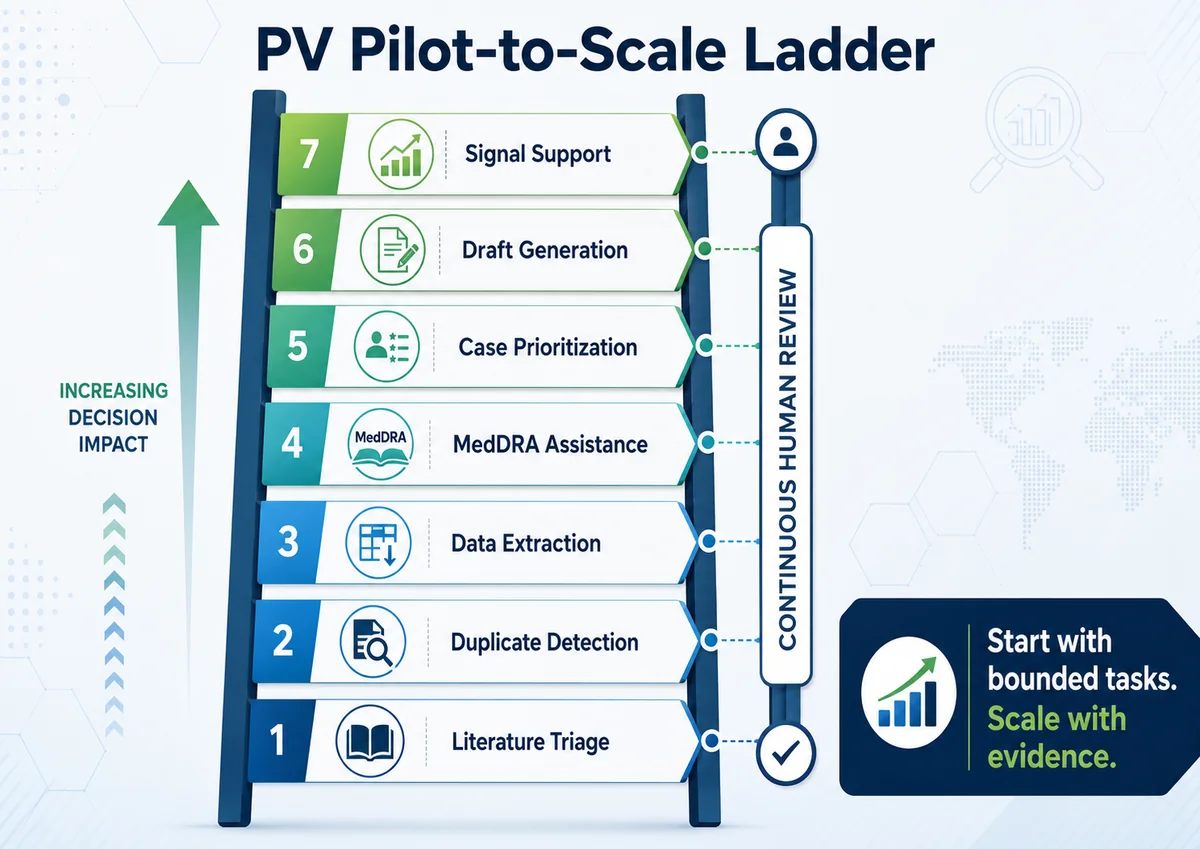
4. MedDRA Coding Assistance
AI can suggest MedDRA terms using source descriptions, context, and historical coding patterns. The appropriate initial model is decision support, with a qualified coder accepting, modifying, or rejecting each suggestion.
Evaluate agreement, correction patterns, rare or ambiguous terms, and performance after dictionary updates. Confidence scores can prioritize review, but should not trigger automatic approval.
5. Case Prioritization
AI may rank incoming cases using potential seriousness, regulatory due dates, missing information, or workflow risks.
Run the ranking alongside the existing triage process. Investigate material disagreements, especially when a potentially serious report receives lower priority. Queue optimization may be supported by AI, but seriousness, expectedness, validity, and reportability remain controlled professional assessments.
6. Narrative and Aggregate Report Drafting
Generative AI can prepare first drafts of ICSR narratives or descriptive aggregate-report sections using controlled source data.
Fluent text can still contain incorrect dates, units, sequences, or unsupported clinical statements. Generated statements should remain traceable to approved sources. Qualified reviewers must retain responsibility for accuracy, scientific interpretation, and final approval.
The workflow should align with controlled aggregate report writing, medical review, approval, and version management.
7. Signal Detection Support
AI can rank statistical associations, combine evidence sources, and reduce noise across large datasets. It should not autonomously confirm signals or determine benefit-risk implications.
This is a later-stage pilot because ground truth may be incomplete and false positives can increase review burden. Signal-management pilots must remain aligned with EMA GVP Module IX and applicable requirements. CIOMS Working Group XIV similarly frames AI as intelligence augmentation that preserves human specialist contribution.
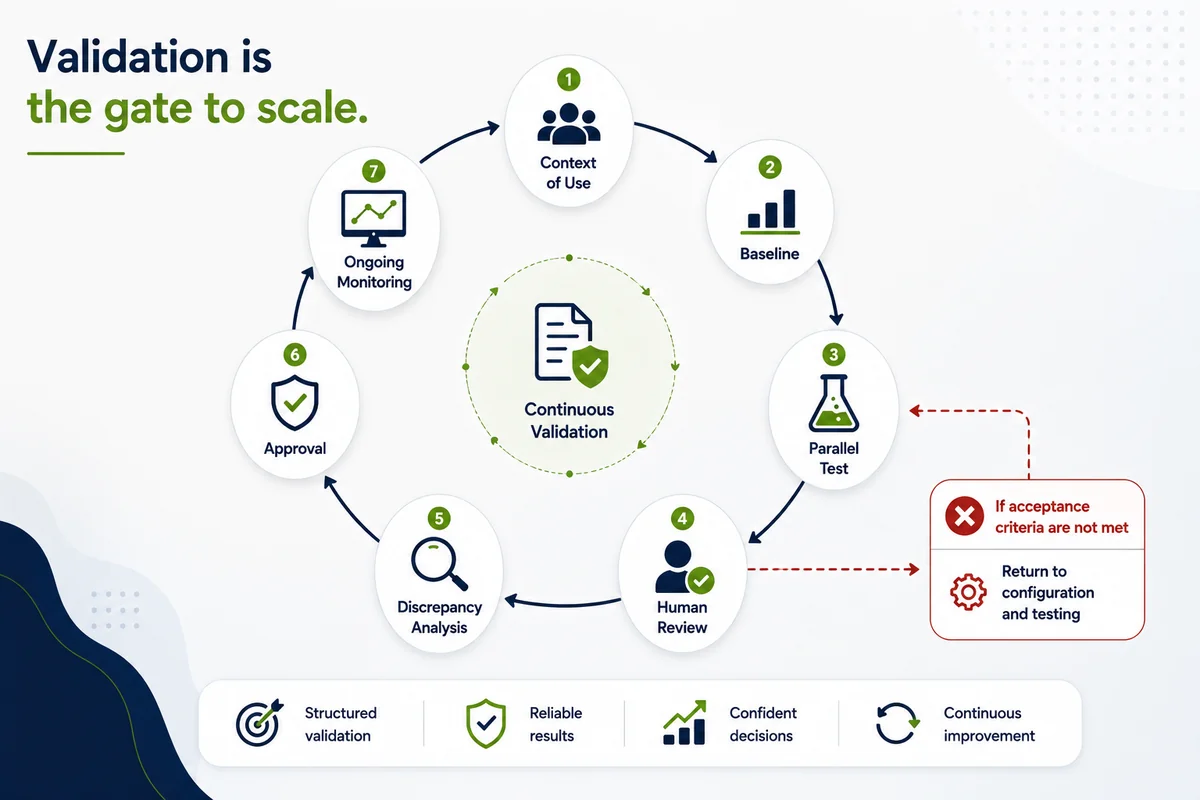
Build Validation Into Every AI Pilot
Before testing, define the context of use, users, data sources, operating boundaries, human decisions, and fallback process. Establish a representative test dataset and risk-proportionate acceptance criteria.
The validation package should address false positives, false negatives, bias, data quality, model changes, access control, audit trails, incident management, and ongoing monitoring. Reassess performance when data sources, dictionaries, workflows, or regulatory requirements change.
A pilot is not successful merely because it saves time. It must show that the organization can detect failures, explain outputs, retain qualified human control, and govern the model throughout its lifecycle.
Move From Pilot to Controlled Operation
PVCON Consulting supports organizations through pharmacovigilance consulting, regulatory intelligence, training and upskilling, and quality-system review. These services can help establish AI governance, validation, competency requirements, change controls, and inspection-ready evidence.
PVCON Consulting supports pharmaceutical, biotechnology, CRO, and medical device organizations through specialized services including GxP Audits, PV Audits, GCP Audits, Other GxP Audits, Pharmacovigilance Consulting, PV Quality Management System support, PvOIC services, Regulatory Intelligence, Medical Writing, Aggregate Report Writing, Clinical Safety Documents, RMP and REMS Writing, PSMF Management, and Training & Upskilling initiatives such as Training Matrix, Regulatory Compliance Training, PV Boot Camp, and Customized Learnings.
Our expertise helps organizations strengthen drug safety operations, improve inspection and audit readiness, and keep PSMF documentation compliant, accurate, and aligned with real-world PV system practices and regulatory expectations.
If you are assessing which pharmacovigilance process is suitable for a controlled AI pilot, you can contact our team or learn more about us.