Decentralized Trials and Pharmacovigilance
Learn why decentralized clinical trials require stronger pharmacovigilance systems for AE reporting, DHT monitoring, local HCP oversight, and inspection readiness.
Decentralized Trials and Pharmacovigilance: Is Your PV System Ready?
Decentralized clinical trials are changing where and how safety information is generated.
With telehealth visits, home healthcare, local healthcare providers, digital health technologies, ePRO tools, wearable devices, local laboratories, and direct-to-patient models, clinical trial activity is no longer limited to traditional investigator sites.
The FDA's 2024 guidance on clinical trials with decentralized elements reinforces this shift by addressing areas such as safety monitoring, adverse event management, local healthcare provider involvement, electronic systems, investigational product delivery, and study records in decentralized trial settings.
The challenge is not decentralization itself.
The challenge is that some pharmacovigilance systems may not yet be fully adapted to decentralized, multi-source clinical trial workflows.
Key Takeaway
Decentralized trials in pharmacovigilance expand the safety data perimeter by creating more sources of safety-relevant information.
Adverse events may now be identified through telehealth, local HCPs, home nurses, ePRO tools, wearable devices, local labs, or participant-reported channels.
The key question is not whether the trial is decentralized.
It is whether the PV system has been redesigned for decentralized safety data.
How Decentralized Trials Expand the Safety Data Perimeter
In a traditional clinical trial, safety information usually follows a clear, site-led pathway:
Participant → Investigator Site → Investigator Assessment → Clinical and PV Pathway → Safety Team
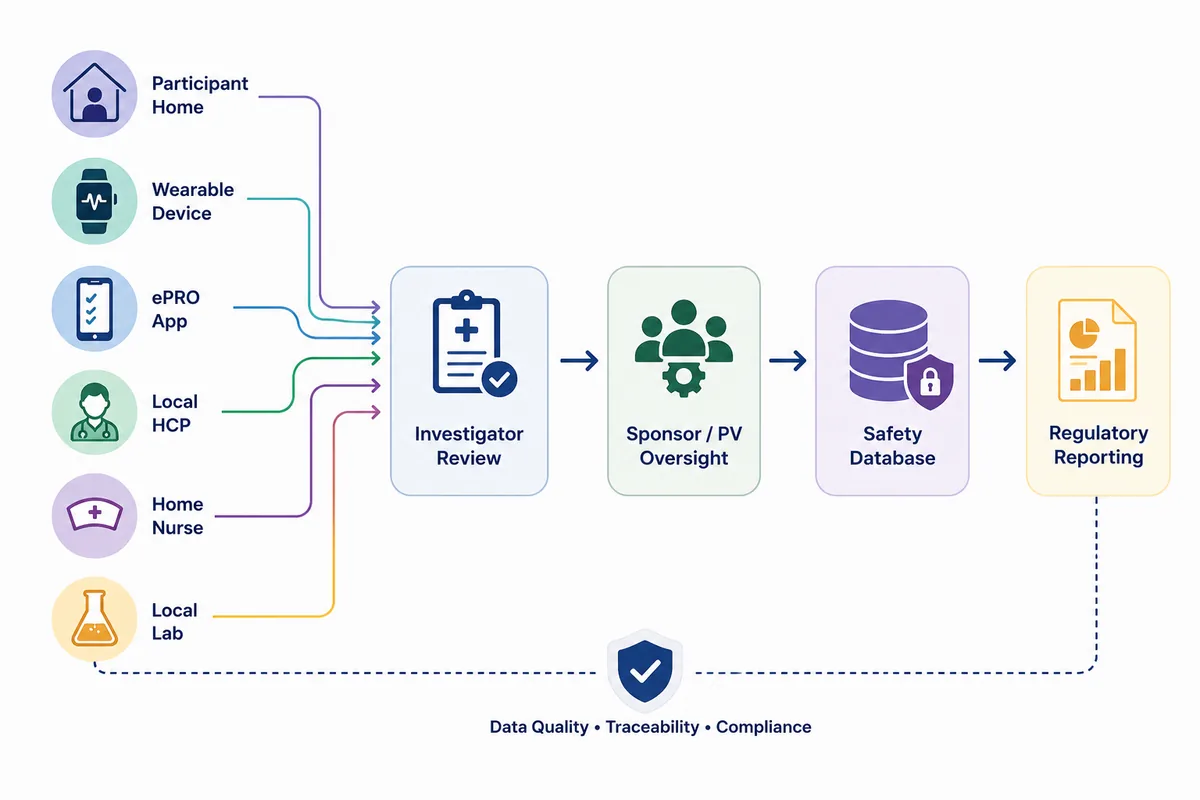
Decentralized trials expand this model by introducing additional sources such as telehealth, home nursing, local HCPs, wearable alerts, ePRO tools, participant apps, local labs, and direct-to-patient delivery.
Multiple Safety Sources → Defined Reporting Pathway → Investigator and PV Review → Safety Team
This broader model may support earlier safety identification, but it also creates more points where information can be delayed, incompletely documented, or missed. Clear ownership, escalation, and reconciliation processes are therefore essential.
Why Site-Centric PV Workflows May Need Reassessment
| Traditional Trial PV Model | Decentralized Trial PV Reality |
|---|---|
| Safety data mainly flows through investigator sites | Safety data may arise from participants, local HCPs, home nurses, DHTs, ePRO tools, and telehealth providers |
| AE capture is site-centered | AE capture becomes multi-source |
| Safety review is often visit-based | Safety concerns may appear between scheduled visits |
| Reconciliation is periodic | Reconciliation may need to be more frequent and better governed |
| Oversight focuses mainly on sites and CROs | Oversight must extend to vendors, local providers, digital tools, and remote trial personnel |
This does not mean decentralized trials are inherently less controlled.
It means the safety system must be built for a broader operating model.
Where clinical platforms, ePRO tools, DHT systems, and safety databases are not connected through clear data exchange processes, safety teams may face delayed reconciliation, duplicate review effort, and weak traceability.
The Safety Monitoring Plan Becomes the Control Point
In decentralized trials, the safety monitoring plan becomes one of the most important control documents.
It should clearly define which decentralized sources may generate safety information, how adverse events and medication errors are reported, who reviews safety information, how urgent events are escalated, how DHT alerts are handled, and how data is reconciled across clinical and safety systems.
This plan should also address local HCP instructions. A local physician, nurse, laboratory, or telehealth provider may become aware of concerning signs, symptoms, or clinical events before the investigator or sponsor safety team.
Without clear reporting expectations, safety information may remain outside the formal PV pathway.
For sponsors building or reassessing these pathways, Pharmacovigilance Consulting can help align safety monitoring plans, AE reporting routes, and operational responsibilities with decentralized trial realities.
DHTs Create Safety Oversight Questions
Digital health technologies are often discussed as endpoint collection tools. For pharmacovigilance, they also create safety oversight questions.
A wearable alert may not automatically equal an adverse event. However, the protocol and safety monitoring plan should define how such alerts are reviewed, who evaluates clinical relevance, when the investigator is informed, and how the review is documented.
This is especially important for clock-start interpretation.
In a site-centric trial, awareness may be easier to define when the investigator or site team receives safety information directly. In a decentralized trial, safety information may first appear in a cloud platform, app, local provider record, or DHT dashboard before human review.
Sponsors should define how awareness is determined across these systems before trial launch.
Oversight Must Extend Beyond the Site
Decentralized trials often involve CROs, telehealth providers, home nursing providers, local HCPs, local labs, DHT vendors, ePRO vendors, logistics providers, and direct-to-patient investigational product vendors.
Delegation does not reduce accountability.
If a local HCP identifies a concerning symptom, if a wearable generates an alert, or if a logistics provider reports a temperature excursion affecting investigational product quality, the PV system must define how that information is recognized, routed, assessed, and documented.
The risk is not simply that more parties are involved.
The regulatory concern is unclear ownership, escalation, and documentation of safety handoffs.
This is where PV Audits and GCP Audits can help assess whether delegated activities, remote providers, and decentralized workflows are governed with sufficient evidence.
Inspection Readiness Depends on Traceability
In a decentralized trial, the sponsor should be able to reconstruct where safety information originated, who received it, whether it was recognized as safety-relevant, when the investigator and sponsor were informed, how the information entered the safety database, and whether follow-up was completed.
This aligns with the wider direction of modern GCP, where fit-for-purpose quality approaches, digital data sources, and risk-based oversight place greater emphasis on reliable records and traceability.
The more decentralized the trial, the more important it becomes to prove that safety data remained controlled from source to regulatory decision.
A strong PV Quality Management System helps ensure that safety processes, documentation, oversight, and escalation pathways remain aligned as trial models become more distributed.
What Sponsors and MAHs Should Reassess
Sponsors and MAHs involved in decentralized or hybrid clinical trials should reassess five priority areas: safety monitoring plan readiness, AE and SAE reporting routes, DHT alert and ePRO review, vendor and local provider oversight, and inspection traceability.
The objective is not to add complexity for its own sake.
The objective is to ensure that participant safety, regulatory reporting, and system oversight remain controlled when trial activities move outside the traditional site environment.
Organizations can also use Regulatory Intelligence to monitor evolving expectations around decentralized clinical trials, digital health technologies, and inspection readiness.
How PVCON Consulting Supports Decentralized Trial PV Readiness
PVCON Consulting supports pharmaceutical, biotechnology, CRO, and medical device organizations through specialized services including GxP Audits, PV Audits, GCP Audits, Other GxP Audits, Pharmacovigilance Consulting, PV Quality Management System support, PvOIC services, Regulatory Intelligence, Medical Writing, Aggregate Report Writing, Clinical Safety Documents, RMP and REMS Writing, PSMF Management, and Training & Upskilling initiatives such as Training Matrix, Regulatory Compliance Training, PV Boot Camp, and Customized Learnings.
Our expertise helps organizations strengthen drug safety operations, improve inspection and audit readiness, and keep PSMF documentation compliant, accurate, and aligned with real-world PV system practices and regulatory expectations.
If you are preparing your PV system for decentralized or hybrid trials, you can contact our team or learn more about us.