GCP Audit Readiness in India: Sites, CROs & Vendors
Why well-documented trials still face GCP audit findings in India, plus a tracer-based mock audit method for sites, CROs and vendors.

GCP Audit Readiness in India: Why Audits Fail Before the Auditor Arrives
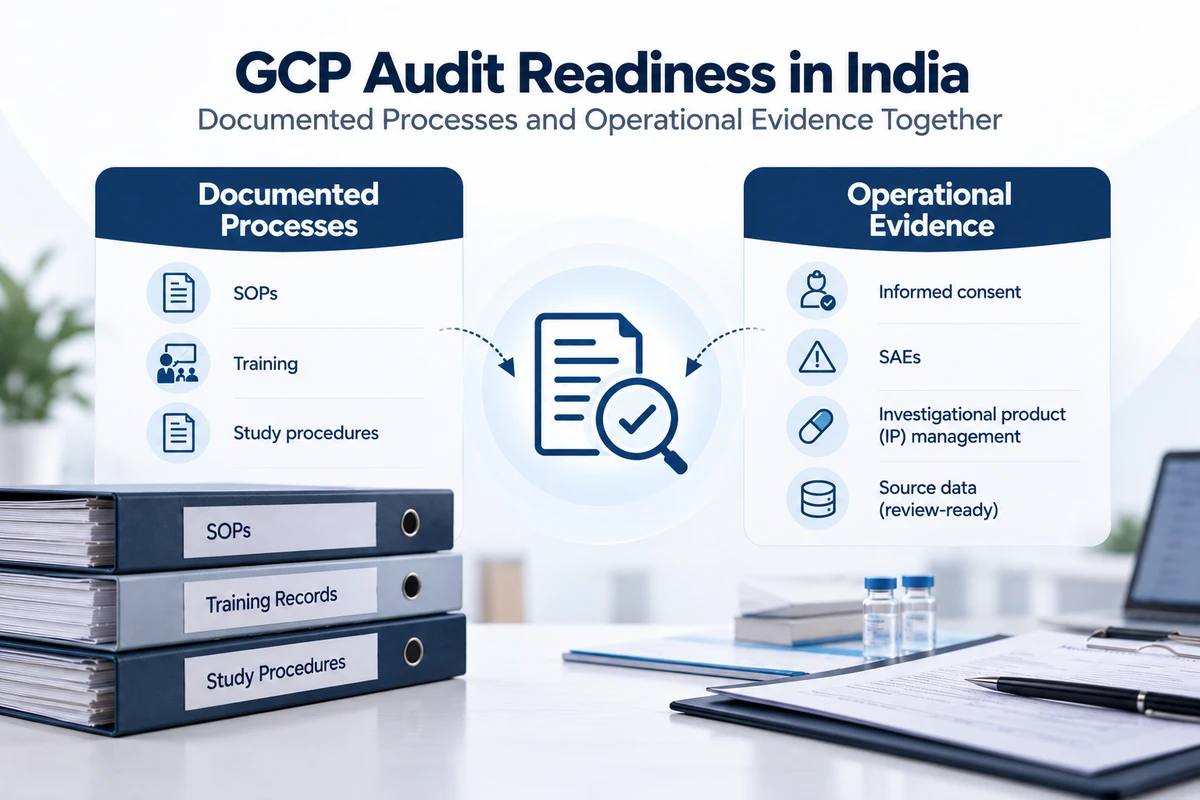
Nine days before a sponsor audit, an investigator site feels ready. The ISF is indexed, SOPs are current and training records are available.
Then the auditor asks: “Walk me through what happened when Subject 014 was hospitalised on a Saturday.” The team knows the procedure but cannot reconcile who reported the SAE, when the CRO was informed and why two systems show different dates.
This composite scenario captures the problem: the binder states the process, but operations show whether it worked.
Key Takeaway
GCP audit readiness in India is a standing state of control across the site, CRO, sponsor and vendors. Critical activities should be traceable end to end, with evidence of execution, escalation and oversight.
Why do well-documented trials still face GCP audit findings?
A complete file can still contain an incomplete operational story. Auditors assess whether records, systems, responsibilities and staff explanations are consistent.
A clinical trial site audit may reveal mismatched delegation records or an unclear out-of-hours safety pathway.
What has ICH E6(R3) changed for sponsors running trials in India?
ICH E6(R3) strengthens quality by design, risk-proportionate controls, clear responsibilities and oversight of transferred activities. Principles and Annex 1 reached Step 4 in January 2025. Annex 2 was adopted on 3 June 2026, adding considerations for decentralised, pragmatic and real-world-data elements.
For India, CDSCO continues to list its September 2024 revised Indian GCP guideline as a draft. ICH E6(R3) should not be described as automatically creating an Indian statutory requirement. Applicable NDCT Rules and Indian GCP requirements remain central.
Tasks may be transferred or delegated, but the sponsor or investigator retains overall responsibility for their respective activities.
Where does a clinical trial site audit expose weakness?
Site readiness is demonstrated when participant protection, protocol conduct and data generation can be reconstructed consistently. Test informed consent, delegation, training, source-to-CRF consistency, protocol deviations, investigational product accountability and SAE escalation.
Under the NDCT Rules, investigators must report serious adverse events to the Central Licensing Authority, sponsor or representative and approving Ethics Committee within 24 hours. Out-of-hours escalation must therefore work in practice.
India also requires audio-video recording of informed consent for vulnerable subjects in clinical trials of a New Chemical Entity or New Molecular Entity. For anti-HIV and anti-leprosy drug trials, the provision specifies audio recording.
Where does CRO oversight break down?
CRO oversight becomes vulnerable when responsibilities are defined but sponsor review cannot be demonstrated. ICH E6(R3) expects transferred activities to be documented, providers assessed for suitability and relevant information available for oversight, including important subcontracted activities.
In India, CRO registration for applicable clinical trial and BA/BE activities became mandatory from 1 April 2025. Oversight should consider regulatory status alongside escalation and quality indicators.
What is the vendor blind spot in clinical trials?
A vendor audit in clinical trials should go beyond qualification. eTMF, EDC, IRT, central laboratory and courier providers may each hold part of the evidence trail. Systems should be fit for purpose, audit trails accessible and significant issues escalated.

How do you test GCP audit readiness the way an auditor would?
Use a tracer-based GCP mock audit:
- Trace one participant through consent, eligibility, visits, source data and CRF entries.
- Trace one SAE through awareness, reporting, follow-up and escalation.
- Trace one investigational product shipment through receipt, storage, dispensing and accountability.
- Interview the people who performed the activities.
- Compare their answers with SOPs, systems and records.
| What the document says | What the auditor tests | Typical operational weakness |
|---|---|---|
| SAE SOP approved | 24-hour pathway | No reliable out-of-hours escalation |
| CRO oversight plan signed | Sponsor review evidence | Review not documented |
| eTMF vendor qualified | Audit-trail retrieval | Functionality not tested |
Request a tracer-based GCP mock audit: PVCON can independently assess investigator sites, CROs and clinical vendors before a sponsor audit or regulatory inspection.
What does “always audit-ready” look like?
Always audit-ready organisations build quality oversight into trial governance through risk-based planning, metrics, timely escalation and periodic mock audits.
In a PVCON India GCP audit programme covering six clinical trial sites and two CROs, 22 findings were closed before submission and TMF completeness improved from 80% to 98%.
GCP audit readiness in India is not a final-fortnight documentation exercise. Start with one participant, one SAE and one shipment, then trace them end to end.
PVCON Consulting supports pharmaceutical, biotechnology, CRO, and medical device organizations through specialized services including GxP Audits, PV Audits, GCP Audits, Other GxP Audits, Pharmacovigilance Consulting, PV Quality Management System support, PvOIC services, Regulatory Intelligence, Medical Writing, Aggregate Report Writing, Clinical Safety Documents, RMP and REMS Writing, PSMF Management, and Training & Upskilling initiatives such as Training Matrix, Regulatory Compliance Training, PV Boot Camp, and Customized Learnings.
Our expertise helps organizations strengthen drug safety operations, improve inspection and audit readiness, and keep PSMF documentation compliant, accurate, and aligned with real-world PV system practices and regulatory expectations.
PVCON provides independent GCP Audit Services for investigator sites, CROs and clinical trial service providers across India. Contact PVCON Consulting.