Local PVoI India: What Global MAHs Need Before Outsourcing
Hiring a Local PVoI in India? Understand MAH responsibilities, reporting timelines, SDEA controls, provider oversight and outsourcing risks.
Hiring a Local PVoI in India? What Global MAHs Need to Know Before Outsourcing
A global MAH can appoint a qualified Local PVoI and still build an ineffective Indian pharmacovigilance system.
Consider a regulatory query arriving on Friday afternoon. The Local PVoI is based in India but cannot access the global safety database. The distributor has not completed case reconciliation and approval authority for the response is unclear.
The appointment exists. The system does not.
Before outsourcing, the required standard is simple: the Local PVoI should be able to explain, access and evidence the Indian PV system when it matters.
Key Takeaway
Use a five-step approach:
Identify the Indian MAH → define Local PVoI authority → establish the SDEA → test safety-data access → monitor provider performance.
Outsourcing should make local pharmacovigilance clearer, not create another handoff.
Who carries the MAH obligation in India?
This should be established before selecting a Local PVoI.
India's 2024 Pharmacovigilance Guidance Document describes the MAH as the manufacturer, marketer or importer holding the relevant valid licence in India.
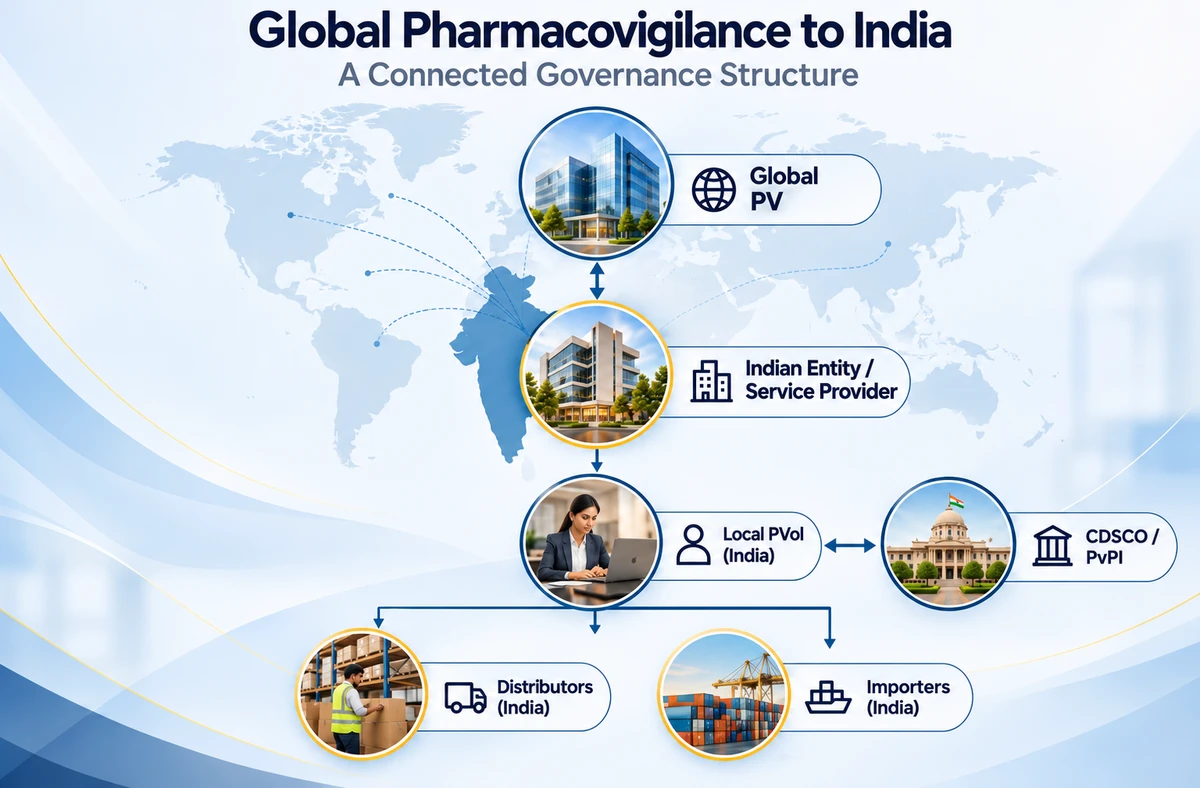
For a global company using a third-party importer or distributor, this distinction matters. If the Indian partner holds the relevant import licence, its position in the PV model cannot be treated as purely commercial. Distribution and other contractual arrangements should be mapped within the PV system and responsibilities clearly defined.
The official guidance uses Pharmacovigilance Officer-in-Charge (PVOIC). PVCON uses Local PVoI as its service terminology while mapping the role to the applicable PVOIC provisions.
The Local PVoI should be medically or pharmacy qualified, appropriately trained and resident in India. The guidance also requires a Deputy PVOIC with the same qualification requirements to act during absence.
For the underlying requirements, see the official Pharmacovigilance Guidance Document for MAHs, Version 2.0.
What regulatory timelines must the model support?
Local access and escalation should support actual Indian reporting timelines.
The current MAH guidance requires:
- Serious adverse events to be reported within 15 calendar days of receipt from any source
- Non-serious adverse events within 90 calendar days
- Literature review at least weekly
For new drugs, the NDCT Rules require PSURs every six months for the first two years after approval and annually for the subsequent two years. The Central Licensing Authority may extend this period in the interest of public health.
What should global MAHs assess before outsourcing?
Qualifications are the starting point. The wider assessment should test whether the provider can actually operate within the MAH's system.
| Criterion | Question to ask |
|---|---|
| Authority | What can the Local PVoI review, approve and escalate? |
| Access | Can cases, signals and supporting records be retrieved immediately? |
| Backup | Who assumes responsibilities during absence? |
| SDEA | Are transfer timelines, reconciliation and escalation defined? |
| Literature | Who performs weekly screening and covers relevant Indian sources? |
| Provider QMS | Can the provider show SOPs, training, deviations, CAPAs and audit evidence? |
PVCON's inspection-readiness work has repeatedly highlighted limited PVOIC visibility, weak vendor oversight and ineffective CAPA execution as recurring system-level risks.
How should global PV governance and the Local PVoI work together?
The Local PVoI should not operate as an isolated local representative.
Global PV governance may retain organisation-level benefit-risk and signal decision processes, while the Local PVoI ensures Indian safety information, regulatory expectations and local actions are incorporated appropriately.
The governance model should explicitly define who reviews, recommends, approves, submits and escalates Indian safety matters. These decision rights should be reflected in SOPs, responsibility matrices and relevant agreements.
What should the SDEA define?
Indian guidance specifically states that PV responsibilities between contractual partners should be defined in a drug safety data exchange agreement (SDEA).
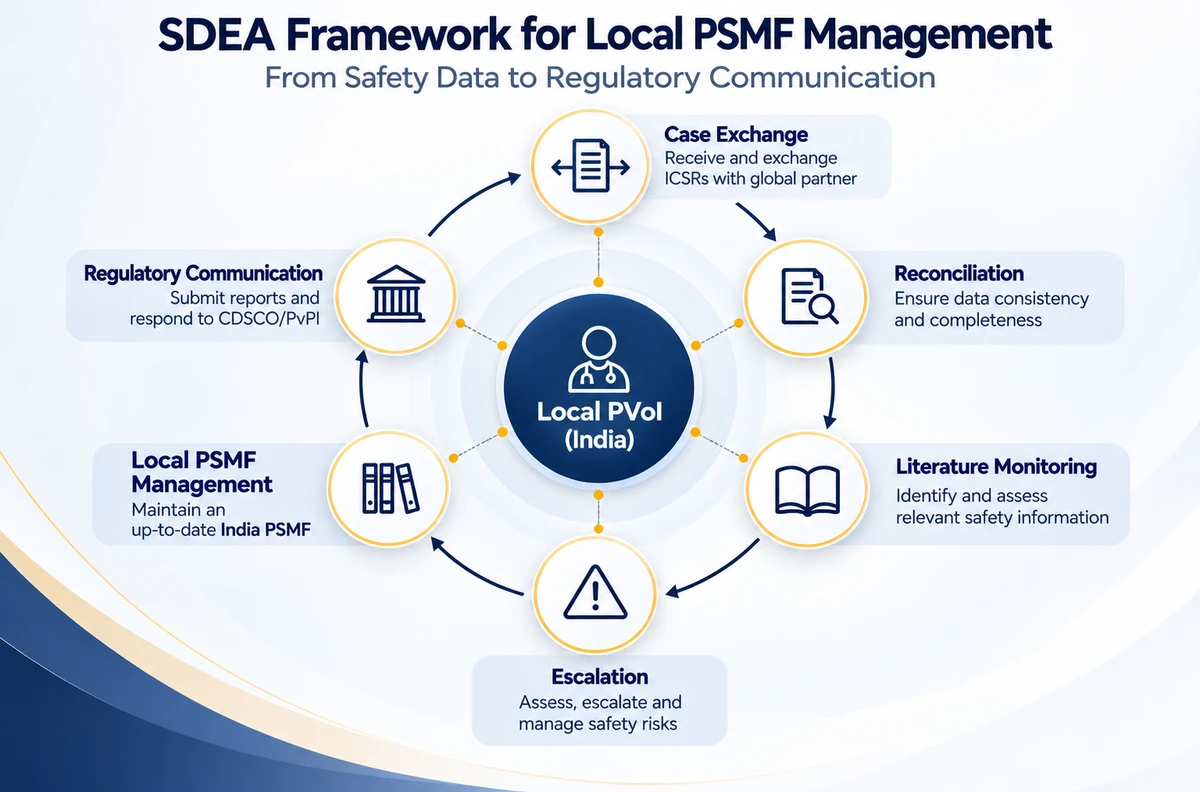
The SDEA should cover case transfer timelines, reconciliation, follow-up, literature responsibilities, regulatory communication, escalation, PSMF updates and transition arrangements.
This is particularly important when distributors, licensing partners or other organisations may independently receive safety information.
What outsourcing red flags should global MAHs look for?
- No qualified deputy: absence can disrupt time-critical PV activities.
- Restricted database access: the Local PVoI cannot independently reconstruct a case.
- Undefined reconciliation: safety information may remain with distributors or partners.
- Generic SDEA language: responsibilities exist without operational timelines.
- Weak literature coverage: weekly screening may not adequately consider Indian journals, relevant digital media and locally important sources.
- Limited provider QMS evidence: outsourced activity becomes difficult to defend during inspection.
Indian guidance also permits inspection of parties performing PV activities wholly or partly for an MAH.
What about cross-border safety data?
Global PV systems routinely transfer ICSR information between India and central safety databases. Indian ICSR records may include identifiers such as patient initials, age or date of birth, gender and reporter information.
India's DPDP framework is being implemented in phases. As of September 2026, many substantive provisions are scheduled to commence on 13 May 2027. Global MAHs establishing outsourcing contracts now should map data flows, access controls, processors and cross-border arrangements before those provisions become operative.
How should a provider transition be managed?
Changing Local PVoI providers requires more than changing contact details.
The handover should address open cases, reconciliation status, regulatory queries, literature activities, system access, SDEA updates, PSMF changes, deviations and pending CAPAs.
Once appointed, provider performance should be reviewed through reporting timeliness, reconciliation completion, literature compliance, regulatory responses, deviations, CAPA effectiveness and periodic audits.
The strongest outsourcing model is one where the Local PVoI can explain the Indian PV system without first having to reconstruct it.
PVCON Consulting supports pharmaceutical, biotechnology, CRO, and medical device organizations through specialized services including GxP Audits, PV Audits, GCP Audits, Other GxP Audits, Pharmacovigilance Consulting, PV Quality Management System support, PvOIC services, Regulatory Intelligence, Medical Writing, Aggregate Report Writing, Clinical Safety Documents, RMP and REMS Writing, PSMF Management, and Training & Upskilling initiatives such as Training Matrix, Regulatory Compliance Training, PV Boot Camp, and Customized Learnings.
Our expertise helps organizations strengthen drug safety operations, improve inspection and audit readiness, and keep PSMF documentation compliant, accurate, and aligned with real-world PV system practices and regulatory expectations.
Need Support With Local PVoI or PV Outsourcing in India?
PVCON supports global and Indian MAHs with Local PVoI services, PV governance, PSMF support, outsourcing oversight and inspection readiness. Contact PVCON Consulting.