Pharmacovigilance QMS Setup: SOPs, CAPA and Governance
Learn how to establish or rebuild a pharmacovigilance QMS covering SOPs, roles, CAPA, metrics, governance and continuous improvement.
Pharmacovigilance QMS Setup: SOPs, Roles, CAPA, Metrics and Governance
Many organisations that believe they have a pharmacovigilance quality management system have little more than a document library.
Their SOPs are approved, indexed and available, but the operating evidence tells a different story.
Responsibilities overlap. Deviations recur. CAPAs close without confirming effectiveness. Management receives activity counts without understanding what they mean for system performance. Over time, the procedures and the work begin to describe two different systems.
A pharmacovigilance QMS must do more than document regulatory expectations. It must create the controls through which work is assigned, performed, monitored, corrected and improved.
The central question is not whether the required procedures exist. It is whether every QMS component operates as part of one connected system.
Key Takeaway
An effective pharmacovigilance QMS connects controlled procedures, defined responsibilities, role-based training, deviation and CAPA management, meaningful metrics, risk-based audits and governance decisions. SOP approval alone does not establish system control.
What Does a Pharmacovigilance QMS Include?
EMA GVP Module I addresses the establishment and maintenance of pharmacovigilance systems and their quality systems.
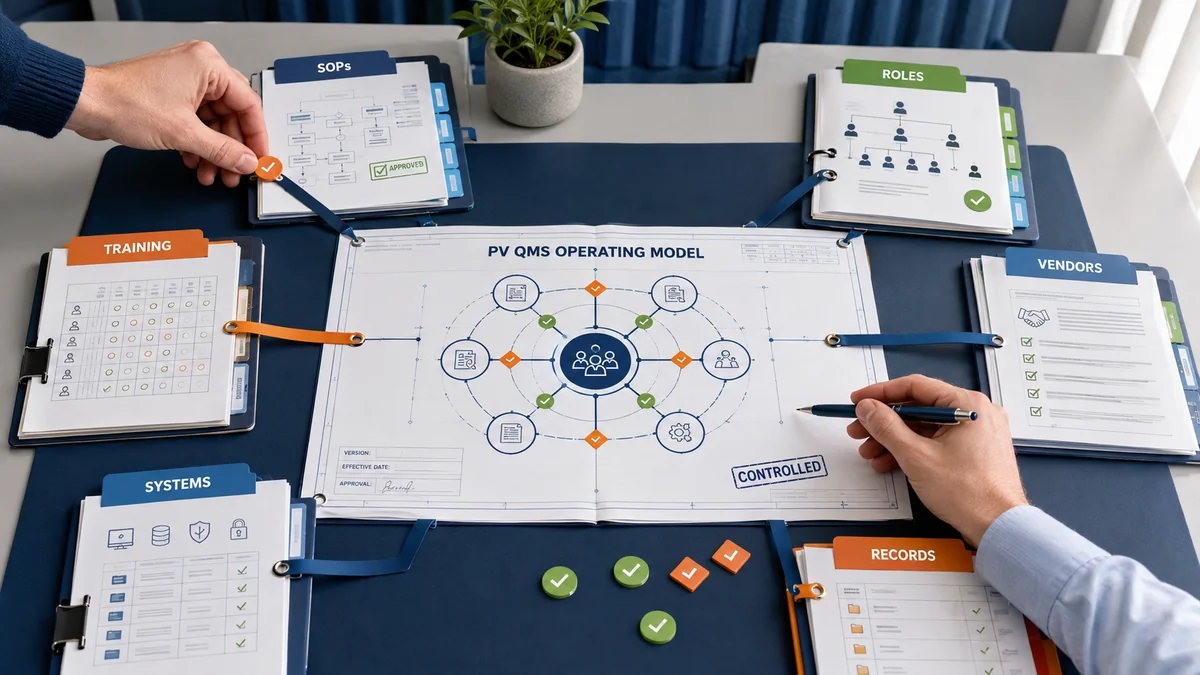
An effective PV QMS connects seven components:
| Component | Function within the QMS |
|---|---|
| SOPs | Define how controlled activities are performed |
| Roles | Assign ownership, review and escalation |
| Training programmes | Prepare personnel for assigned activities |
| Metrics | Show whether controls are working |
| Deviations and CAPA | Identify weaknesses and reduce recurrence |
| Audits | Independently evaluate controls |
| Governance forums | Review evidence and direct improvement |
These components form a continuous cycle. Procedures assign tasks to defined roles. Training prepares personnel to perform them. Metrics and audits reveal weaknesses. CAPAs address causes, while governance determines what the system must change.
Define the System Before Writing SOPs
A new or rebuilt QMS must begin with its operating scope. Writing procedures before understanding the organisation can produce unnecessary documents, missing interfaces and responsibilities that do not reflect actual work.
The design should account for product lifecycle stages, territories, legal entities, safety databases, internal functions, affiliates, vendors and applicable regulatory frameworks.
It must also identify which activities remain internal and which are outsourced. Contracting a service provider does not remove the MAH's responsibility for oversight.
This operating model establishes the foundation for the procedure hierarchy, governance structure and Pharmacovigilance System Master File.
Build SOPs That Reflect Real Operations
Pharmacovigilance SOPs must be controlled, current and usable. A procedure written primarily to appear complete may create commitments that the organisation cannot consistently fulfil.
The SOP architecture may cover safety information intake, ICSR management, literature monitoring, signal management, aggregate reporting, risk management, PSMF maintenance, vendor oversight, training, CAPA, audits and business continuity.
Each process requires the appropriate level of documentation:
| Document type | Primary purpose |
|---|---|
| Policy | Establishes organisational direction |
| SOP | Defines the controlled process and responsibilities |
| Work instruction | Explains how a task is performed |
| Template or form | Standardises information capture |
| Record | Demonstrates that the activity occurred |
Overloading an SOP with task-level detail makes it difficult to maintain. Leaving critical decisions undefined creates inconsistency.
Assign Accountability Beyond the Organisation Chart
An organisation chart shows reporting relationships. It does not explain who owns a safety process, approves an output or acts when a timeline is at risk.
For every critical activity, define the process owner, operational performer, reviewer, approver, escalation recipient and trained backup.
This mapping must extend beyond the PV department. Medical affairs, regulatory affairs, quality, commercial teams, affiliates, vendors and senior management may all hold responsibilities within the system.
Role descriptions must align with the PSMF, procedures, agreements and role-based training matrix.
Use CAPA to Improve the System
A correction resolves an immediate issue. Corrective action addresses the cause of an identified problem. Preventive action reduces the likelihood of a potential problem occurring.
These concepts must not be treated as interchangeable.
Not every deviation requires formal CAPA. The decision should reflect risk, recurrence, systemic impact and procedural criteria.
Where CAPA is required, PV CAPA management should include root-cause evaluation, impact assessment, an accountable owner, defined actions, realistic deadlines and effectiveness verification.
Closing an action because a document was revised or training was completed does not prove that the underlying weakness has been addressed.
Select Metrics That Lead to Decisions
A long dashboard does not automatically provide effective oversight.
Pharmacovigilance metrics require defined owners, reporting frequencies, thresholds, trends and escalation criteria. Measures may include ICSR timeliness, case quality, literature-screening performance, signal milestones, training status, overdue CAPAs and vendor performance.
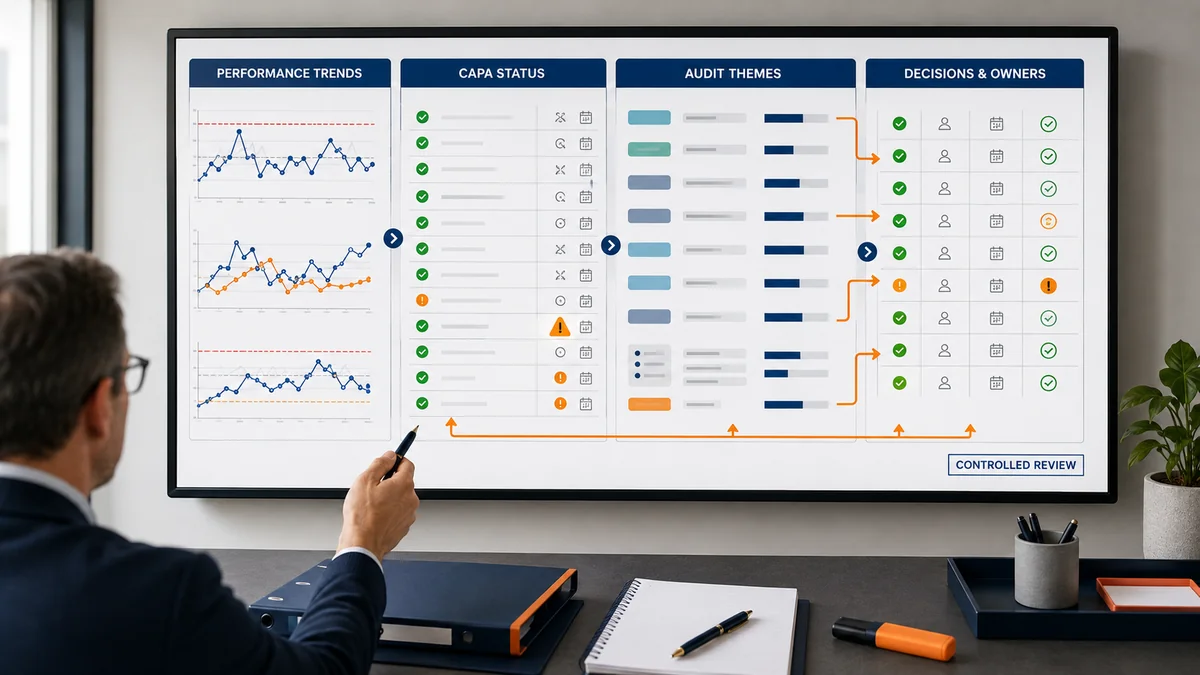
The value of a metric lies in the response it triggers. When performance crosses a threshold, the system must identify who evaluates the issue, what action is required and how the decision is documented.
Govern Through Evidence
Governance is demonstrated through the information reviewed, the authority of participants and the traceability of decisions.
Operational forums may assess case processing, deviations, CAPAs, regulatory changes and vendor delivery. Senior management should focus on system-level risk, resources, quality objectives and significant matters requiring organisational action.
Each forum needs a defined purpose, standard inputs, escalation criteria and decision authority. Actions require accountable owners and follow-up evidence.
Verify That the QMS Operates as One System
Select a recent safety-system issue and confirm whether the QMS:
- Detected it through routine controls
- Assessed its impact and systemic significance
- Assigned action to an accountable owner
- Monitored the response through appropriate metrics
- Verified the effectiveness of completed action
- Escalated significant information through governance
- Updated relevant procedures, training or system documentation
This tests whether the QMS can identify, understand and correct its own weaknesses.
EMA GVP Module IV also addresses risk-based pharmacovigilance audits and follow-up actions arising from audit findings.
When the QMS Works, Readiness Becomes Routine
A stronger QMS reflects how safety activities actually occur. Its procedures remain current. Its roles are understood. Its metrics reveal changes. Its CAPAs address causes. Its governance acts on evidence.
PVCON Consulting supports organisations through pharmacovigilance quality management systems, including QMS framework design, SOP architecture, responsibility mapping, CAPA processes, metrics, governance and vendor oversight.
The objective is not simply to assemble evidence for an inspection. It is to maintain control throughout the product lifecycle.
PVCON Consulting supports pharmaceutical, biotechnology, CRO, and medical device organizations through specialized services including GxP Audits, PV Audits, GCP Audits, Other GxP Audits, Pharmacovigilance Consulting, PV Quality Management System support, PvOIC services, Regulatory Intelligence, Medical Writing, Aggregate Report Writing, Clinical Safety Documents, RMP and REMS Writing, PSMF Management, and Training & Upskilling initiatives such as Training Matrix, Regulatory Compliance Training, PV Boot Camp, and Customized Learnings.
Our expertise helps organizations strengthen drug safety operations, improve inspection and audit readiness, and keep PSMF documentation compliant, accurate, and aligned with real-world PV system practices and regulatory expectations.
To design, rebuild or strengthen your pharmacovigilance QMS, you can contact our team or learn more about us.