Pharmacovigilance Training Effectiveness: How to Measure It
Measure pharmacovigilance training effectiveness through role-based assessments, case simulations, performance data, CAPA evidence and audit-ready records.

How to Measure Pharmacovigilance Training Effectiveness Beyond Attendance and Certificates
Somewhere in most pharmacovigilance organisations, a dashboard reports a reassuring number: 100% training completion.
Everyone attended. Everyone passed. Everyone received a certificate. Yet the organisation may still encounter recurring case-processing errors, delayed escalations or inconsistent procedural decisions.
Attendance is an input, not an outcome.
A certificate confirms that training was completed. It does not demonstrate that an employee can recognise reportable safety information in an unclear patient message, apply seriousness criteria correctly or follow the required escalation route under operational pressure.
A training matrix in pharmacovigilance defines what each role needs to learn. Pharmacovigilance training effectiveness measures whether that learning was understood, applied and sustained in practice.
Key Takeaway
Measure pharmacovigilance training effectiveness at three levels: whether personnel understand the requirement, whether they can apply it in role-specific situations and whether their performance remains within defined expectations.
Use assessments, simulations, quality trends and documented follow-up rather than attendance records alone.
What Does Training Effectiveness Mean?
EMA GVP Module I requires personnel involved in pharmacovigilance activities to receive initial and continued training appropriate to their responsibilities.
The guidance does not prescribe one universal assessment format, passing score or effectiveness metric. Organisations must select a proportionate method based on the role, activity and potential effect of an incorrect decision.
Five measurement levels should remain distinct:
| Level | What it demonstrates |
|---|---|
| Completion | Assigned learning was completed |
| Understanding | The learner understood the content |
| Application | The learner can apply it to a task |
| Operational outcome | Learning is reflected in performance |
| Sustained competence | Correct performance continues over time |
Completion remains necessary evidence. It is simply not the final measure.
Use a Training Effectiveness Maturity Model
The same five levels can be assessed according to the evidence they provide and their limitations:
| Level | Evidence | Limitation |
|---|---|---|
| Completion | Attendance and certificates | Does not demonstrate understanding |
| Understanding | Knowledge checks | May not prove practical application |
| Application | Simulations and observed tasks | Measures one point in time |
| Operational outcome | Quality and error trends | Other system factors may influence results |
| Sustained competence | Reassessment and stable performance | Requires continued oversight |
Not every role needs the same assessment method. The approach should reflect the responsibility performed and the risk associated with an incorrect action.
Match the Assessment to the Role
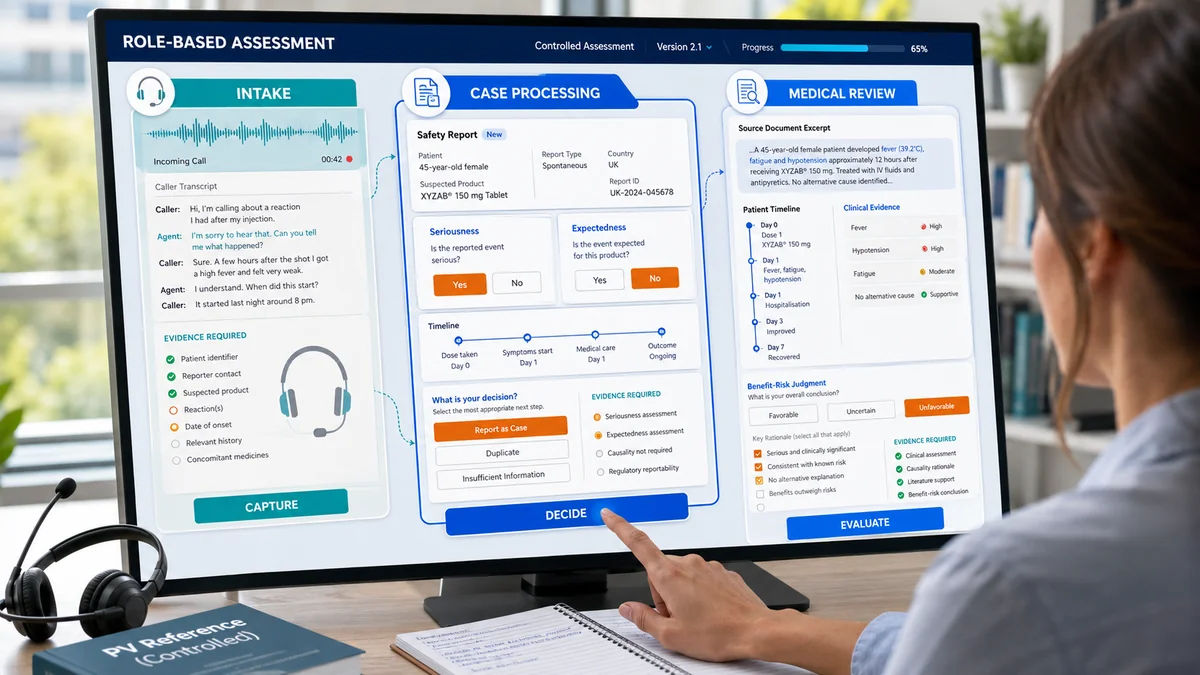
A generic quiz may confirm awareness of terminology, but it provides limited evidence that personnel can make correct decisions in a live PV process.
A field employee may need to recognise and forward potential safety information. A case processor must apply validity, seriousness and reporting criteria. A signal professional requires analytical judgement. Leadership needs to understand accountability and escalation.
| Role | Appropriate assessment |
|---|---|
| Field or call-centre employee | Adverse-event recognition scenario |
| Case processor | Validity, seriousness and timeline exercise |
| Medical reviewer | Medical assessment with rationale |
| Signal professional | Simulated safety issue evaluation |
| Affiliate personnel | Local intake and escalation scenario |
| Senior management | Governance and risk-escalation exercise |
This role-based approach should align with the organisation's training matrix and content development framework, procedures and assigned responsibilities.
Use Case Simulations to Test Application
A pharmacovigilance case simulation can include an incomplete patient-support message, a follow-up report that changes seriousness, a potential duplicate or a literature article with unclear reportability.
Assess whether the learner recognises the safety information, reaches the correct decision, applies the appropriate timeline, identifies the governing procedure, documents the rationale and follows the escalation route.
Scenarios should reflect realistic conditions. Ambiguous details can test judgement, but expected answers and scoring criteria must remain documented and defensible.
Let Operational Performance Test the Training
The most mature evaluation uses controlled operational data to determine whether learning transferred into practice.
Relevant PV training metrics may include case-processing rework, seriousness corrections, late escalations, coding inconsistencies, screening discrepancies and recurring procedural deviations.
Compare performance before and after the intervention. Examine the error types, affected roles, recurrence and whether improvement is sustained.
Operational performance cannot be attributed to training automatically. Workload, unclear procedures, system configuration, supervision or conflicting responsibilities may also influence results.
If errors persist after training, investigate why. The result may indicate weak learning content or a wider QMS concern.
Use CAPA-Linked Training Carefully
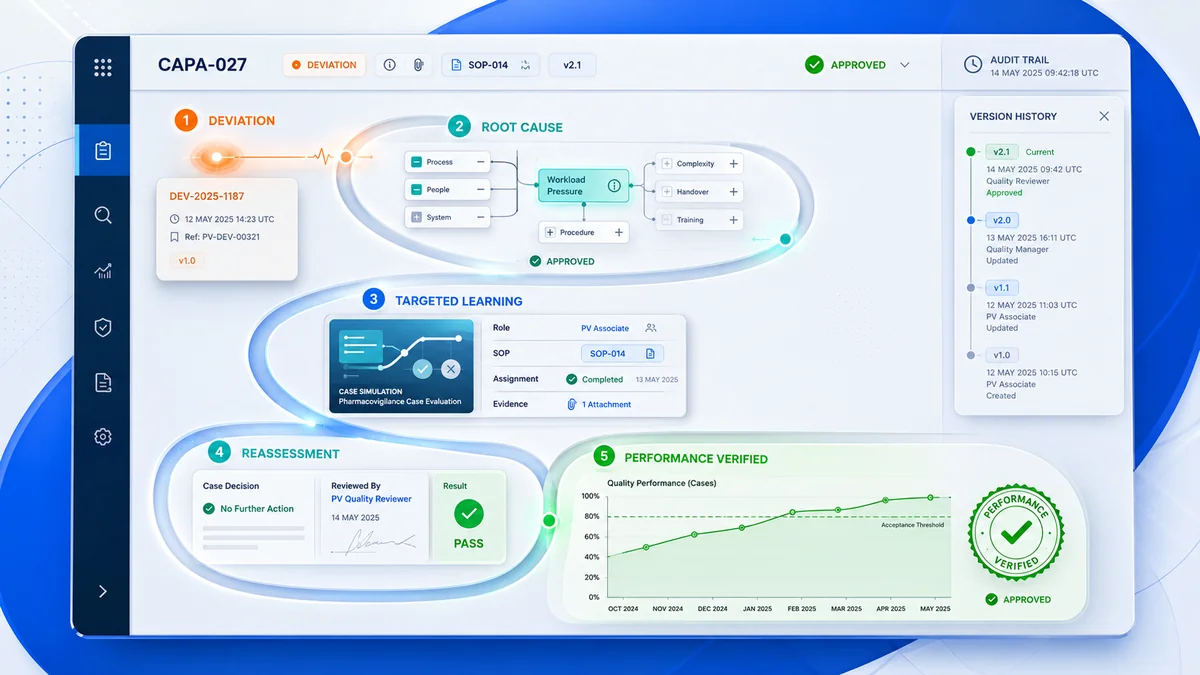
"Retrain the team" is frequently assigned after a deviation or audit finding. It is appropriate only when the root-cause evaluation identifies a knowledge, understanding or application weakness.
If the cause is an unclear SOP, inadequate resources or a system limitation, repeating the course will not address it.
When training forms part of CAPA, define the affected competency, target population, revised intervention, reassessment method, review period and expected improvement.
The training activity may be completed when personnel finish the course. The CAPA effectiveness check remains open until evidence demonstrates that the intended improvement occurred.
Build Audit-Ready Evidence
EMA GVP Module III frames inspections around whether the MAH has the personnel, systems and facilities required to meet its pharmacovigilance obligations.
Training evidence should connect the person, role, curriculum and demonstrated competence.
An audit-ready evidence package may include the role profile, assigned curriculum, approved material, completion record, assessment result, remediation history, assessor qualification and effectiveness evidence.
Traceability matters more than document volume. An inspector should be able to determine what competence the role required, how it was assessed and what happened when the standard was not achieved.
When Should Competence Be Reassessed?
Reassessment may follow a new responsibility, revised procedure, regulatory change, system update, significant deviation, audit finding, extended absence or declining performance.
Critical roles also require periodic review. The frequency should reflect risk and the nature of the activity rather than one universal interval.
Turn Training Data Into Decisions
A mature programme helps management determine who is ready to perform an activity, where support is required and whether an intervention improved performance.
PVCON Consulting supports organisations through Training Matrix and Content Development, Regulatory Compliance Training and customised learning programmes.
The objective is not to replace completion records. It is to place them within an evidence chain showing whether learning changed performance where it mattered.
PVCON Consulting supports pharmaceutical, biotechnology, CRO, and medical device organizations through specialized services including GxP Audits, PV Audits, GCP Audits, Other GxP Audits, Pharmacovigilance Consulting, PV Quality Management System support, PvOIC services, Regulatory Intelligence, Medical Writing, Aggregate Report Writing, Clinical Safety Documents, RMP and REMS Writing, PSMF Management, and Training & Upskilling initiatives such as Training Matrix, Regulatory Compliance Training, PV Boot Camp, and Customized Learnings.
Our expertise helps organizations strengthen drug safety operations, improve inspection and audit readiness, and keep PSMF documentation compliant, accurate, and aligned with real-world PV system practices and regulatory expectations.
To strengthen your pharmacovigilance training and competency framework, you can contact our team or learn more about us.