PSMF Accuracy and PV System Readiness
A clean PSMF is not enough if it does not match the live PV system. Learn how inspectors test PSMF accuracy, QPPV oversight, vendor control, CAPA, signals, and PV operations.
Your PSMF Looks Perfect. Your System Doesn't. Why That Gap Is Now a Critical Finding
A Pharmacovigilance System Master File can look complete on paper. The QPPV is named. Vendors are listed. SOPs are referenced. Safety data sources are described. Annexes are organized.
But inspection readiness is not proven by how polished the PSMF looks.
EMA GVP Module II expects the PSMF to accurately and up-to-date reflect the pharmacovigilance system under the QPPV's responsibility. That makes the PSMF more than a regulatory file. It is the map inspectors use to test the live PV system (EMA GVP Module II).
The problem begins when the map looks perfect, but the system behind it does not match.
A PSMF Is Not a Presentation Document
A PSMF should describe the PV system that exists today, not the version the organization wishes it had.
The risk grows when operations change faster than the file. Vendors change. Products are added. Affiliates take on new responsibilities. Databases migrate. SOPs are revised. Safety sources expand.
If the PSMF is not updated alongside these changes, it stops reflecting the actual PV system accurately.
The seven-day availability requirement adds pressure. EMA guidance states that the PSMF should be made available within seven days of a competent authority request. That means the file should be continuously maintained, not repaired under inspection pressure (EMA GVP Module II).
The Gap Inspectors Follow
A clean PSMF is only the starting point. Inspectors use it as a map, then test whether the live system matches it.
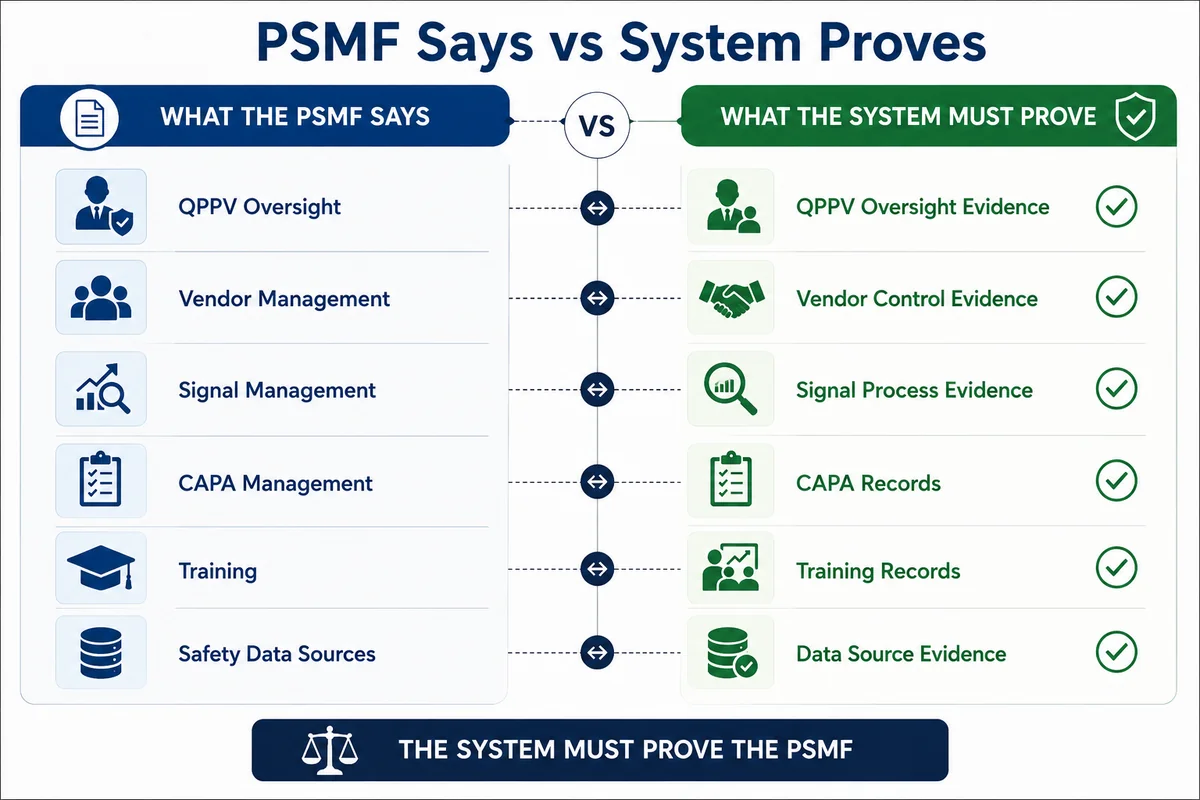
If the PSMF says the QPPV has oversight, inspectors may ask for meeting minutes, escalation logs, compliance reviews, or evidence of access to key PV data. If it describes vendor control, they may sample an outsourced activity and check review, follow-up, deviations, audit rights, and corrective action. If it describes signal management, they may test a real signal decision for source data, medical rationale, prioritisation, QPPV visibility, and closure evidence.
When the PSMF says one thing and the records show another, the issue is not formatting. It is system control.
Example: the PSMF may list a CRO as a controlled vendor. But if the agreement is outdated, audit rights are unclear, issue follow-up is missing, and the CRO uses a workflow that does not match the MAH's process, the PSMF has exposed the gap.
Where the PSMF Usually Stops Matching Reality
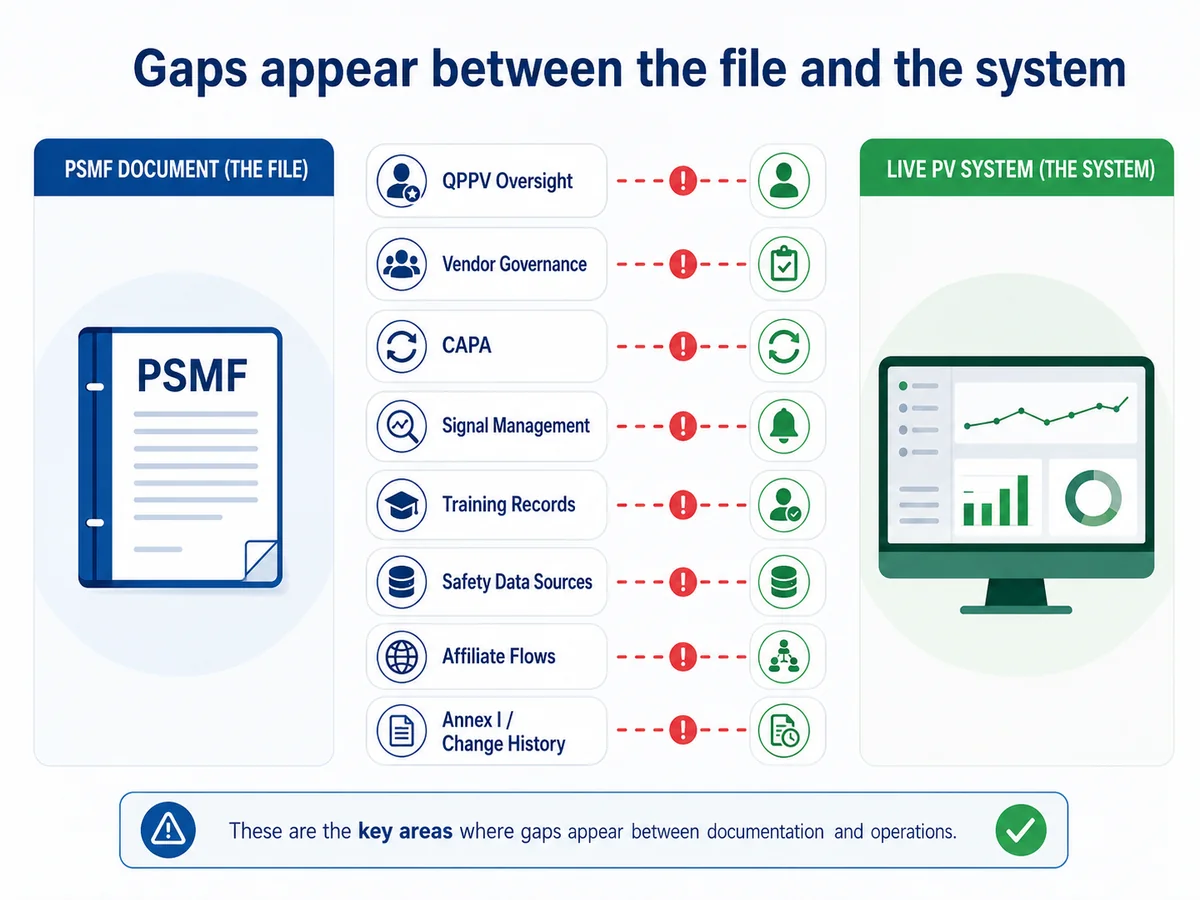
The mismatch often appears in predictable areas:
- QPPV oversight: The PSMF says the QPPV has oversight, but evidence of involvement in major PV decisions, vendor issues, safety concerns, or system changes is weak.
- Vendor governance: Vendors are listed, but scope, performance review, deviations, audit follow-up, or escalation routes are not current.
- Safety data sources: Intake channels are described, but affiliate inputs, literature, patient support programs, partner data, or EudraVigilance-related flows are not fully reflected.
- Signal management: The process is described, but validation, non-validation, prioritisation, or closure decisions lack rationale.
- CAPA: Quality management is referenced, but CAPA records do not show root cause, ownership, timelines, effectiveness checks, and closure.
- Training: Training is described as role-based, but records do not prove people were trained on the current process they perform.
- Annex and change history: The PV system changes, but Annex I or the change log does not clearly show what changed, when, and why.
Vendor Control Deserves Extra Attention
Many MAHs rely on vendors for case processing, literature screening, database activities, signal support, medical writing, or local PV tasks. Outsourcing does not remove accountability from the MAH.
For the PSMF, vendor descriptions should not stop at names and agreements. The live system should prove who does what, how vendor outputs are reviewed, how deviations are handled, how QPPV visibility is maintained, and how changes are reflected in the file.
If the PSMF shows vendor control but the evidence does not, the issue becomes oversight.
The PSMF Should Move With the System
A PV system changes when products, territories, vendors, affiliates, databases, SOPs, safety sources, or governance committees change.
The PSMF should move with those changes.
This does not mean rewriting the file every week. It means having a controlled process that identifies which system changes affect the PSMF, which annexes need updates, who reviews them, and how QPPV oversight is documented.
Ask one simple question:
Would an inspector be able to use the PSMF today and see the same system reflected in live records?
If not, the PSMF is no longer a reliable map.
Practical Checks Before Inspection
Before inspection, test whether the PSMF matches the live system.
Ask:
- Does it reflect current roles, products, territories, vendors, and safety data sources?
- Is QPPV oversight supported by records or governance trackers?
- Do vendor files show active oversight, not just signed agreements?
- Do signal decisions and CAPA records match the described process?
- Are training records aligned with current SOPs and responsibilities?
- Does the change history show major system changes clearly and on time?
Quick test: pick one signal decision, vendor deviation, CAPA, or safety data source and trace it from the PSMF to real evidence. If the trail does not match, that is the readiness gap.
How PVCON Consulting Supports PSMF and System Readiness
A strong PSMF is not the one that reads best. It is the one that accurately reflects how the pharmacovigilance system works.
PVCON Consulting supports pharmaceutical, biotechnology, CRO, and medical device organizations through specialized services including GxP Audits, PV Audits, GCP Audits, Other GxP Audits, Pharmacovigilance Consulting, PV Quality Management System support, PvOIC services, Regulatory Intelligence, Medical Writing, Aggregate Report Writing, Clinical Safety Documents, RMP and REMS Writing, PSMF Management, and Training & Upskilling initiatives such as Training Matrix, Regulatory Compliance Training, PV Boot Camp, and Customized Learnings.
Our expertise helps organizations strengthen drug safety operations, improve inspection and audit readiness, and keep PSMF documentation compliant, accurate, and aligned with real-world PV system practices and regulatory expectations.
If you are evaluating your PSMF or preparing for an inspection, you can contact our team or learn more about us.