Traceback Inspections in Pharmacovigilance
Learn how traceback inspections in pharmacovigilance assess system performance by tracing cases, signals, CAPAs, vendors, audit findings, and PSMF records back to source evidence.
Inspectors Are No Longer Just Reading Your SOPs. Why Inspectors Test the System Backwards
For many pharmacovigilance teams, inspection readiness has traditionally focused on documentation availability, including approved SOPs, completed training records, updated trackers, accessible PSMF records, and filed vendor agreements.
These elements remain important. However, they do not, by themselves, demonstrate that the pharmacovigilance system operated effectively when tested through real safety activity.
In current inspection practice, the assessment is increasingly evidence-led. Inspectors may begin with a specific case, signal, CAPA, vendor record, audit finding, clinical safety document, or PSMF entry and trace the process backwards.
This traceback inspection approach reveals what documentation alone may not show: whether the system worked as described.
Key Takeaway
Inspectors are no longer reviewing SOPs in isolation.
They are testing whether pharmacovigilance systems can reconstruct real activities from outcome back to source.
A traceback inspection may begin with an ICSR, signal decision, vendor record, CAPA, audit finding, clinical safety document, or PSMF entry. The process is then followed backwards to assess timelines, ownership, decision rationale, oversight, and evidence quality.
The key inspection question is not whether the process is documented.
It is whether the system worked as described.
From Horizontal Review to Vertical Reconstruction
Traditional readiness checks often follow a horizontal approach.
A quality team may review SOP approval status, training records, trackers, or report submissions across different functions. This confirms whether individual quality system elements are in place.
A traceback inspection works differently.
| Review Type | Focus | Inspection Value |
|---|---|---|
| Horizontal review | Checks one quality element across multiple areas | Confirms document and process availability |
| Traceback inspection | Traces one real PV activity backwards across multiple steps | Confirms whether the system operated as described |
For example, an inspector may select one serious ICSR and trace it backwards from regulatory submission to first receipt, reviewing intake, assessment, medical review, quality control, submission, reconciliation, and vendor or affiliate handoff.
The question is not only whether each step is described in an SOP.
It is whether the evidence confirms that each step happened correctly, on time, and under appropriate oversight.
Why SOPs Alone Do Not Prove System Control
SOPs define the intended process, including responsibilities, timelines, escalation pathways, and documentation expectations.
But an SOP does not prove execution.
In many PV systems, inspection concerns arise when written procedures and operational practice become misaligned. This may happen when local intake routes are not reflected in global procedures, vendors follow different escalation practices, or affiliate handoffs are not consistently documented.
This creates operational decoupling.
The documented system may appear controlled, while daily practice relies on workarounds, assumptions, or undocumented handoffs.
A traceback inspection surfaces this difference by testing whether records, timelines, decisions, and evidence can reconstruct the actual pathway of a PV activity.
Periodic regulatory findings across multiple authorities have consistently underscored the inspection implications of this type of operational misalignment.
What Traceback Inspections Commonly Reveal
1. Timeline Weaknesses
A final regulatory submission date may appear compliant, but the full chronology may show avoidable delay before submission.
Inspectors may review when information was first received, when it became available to the MAH or partner, when it entered the safety database, when assessment occurred, when follow-up was initiated, and when quality review was completed.
If the internal timeline cannot be reconstructed, the system may be difficult to defend.
2. Vendor Oversight Limitations
Outsourcing does not remove MAH accountability.
A vendor agreement may define responsibilities, but traceback inspection testing may show whether oversight was active and evidence-based. Inspectors may review reconciliation logs, late case trends, quality checks, deviation handling, escalation records, and CAPA follow-up.
The regulatory concern is not only that an outsourced activity had an error. The concern is whether the MAH had sufficient visibility to identify, assess, and correct the issue.
For organizations managing delegated PV activities, PV Audits and PV Quality Management System support become important for assessing whether oversight is documented, traceable, and effective.
3. Signal Decision Traceability
Signal management decisions must be scientifically and procedurally defensible.
A traceback inspection may begin with a closed signal and move backwards through data sources, validation rationale, medical assessment, prioritisation, meeting minutes, governance approval, and regulatory action where applicable.
A signal log alone is not enough if the rationale behind the decision cannot be reconstructed.
This is especially important because signal decisions are not only operational records. They are evidence of benefit-risk oversight.
4. CAPA Closure Without Effectiveness Evidence
CAPA closure is often treated as the end of the issue. Inspectors may treat it as the beginning of a deeper review.
If a CAPA was closed after retraining, SOP revision, or process clarification, inspectors may examine whether the same issue occurred again. They may assess whether root cause analysis was adequate and whether effectiveness was verified.
Administrative closure does not demonstrate that the issue has been addressed.
Evidence of effectiveness is what confirms whether the action resolved the underlying system-level weakness.
This is one reason CAPA review should not be limited to whether the action was completed. It should assess whether the action addressed the underlying system-level weakness.
5. PSMF Misalignment
The PSMF should accurately reflect the pharmacovigilance system as it operates.
A traceback inspection may begin with a PSMF statement and compare it with vendor records, affiliate arrangements, audit status, CAPA logs, safety database information, and current operational responsibilities.
If the PSMF does not reflect current operations, the issue is not only document maintenance. It may indicate weaknesses in governance, change control, and inspection preparedness.
For organizations managing complex global and local PV structures, PSMF Management and controlled system oversight are essential to maintaining inspection readiness.
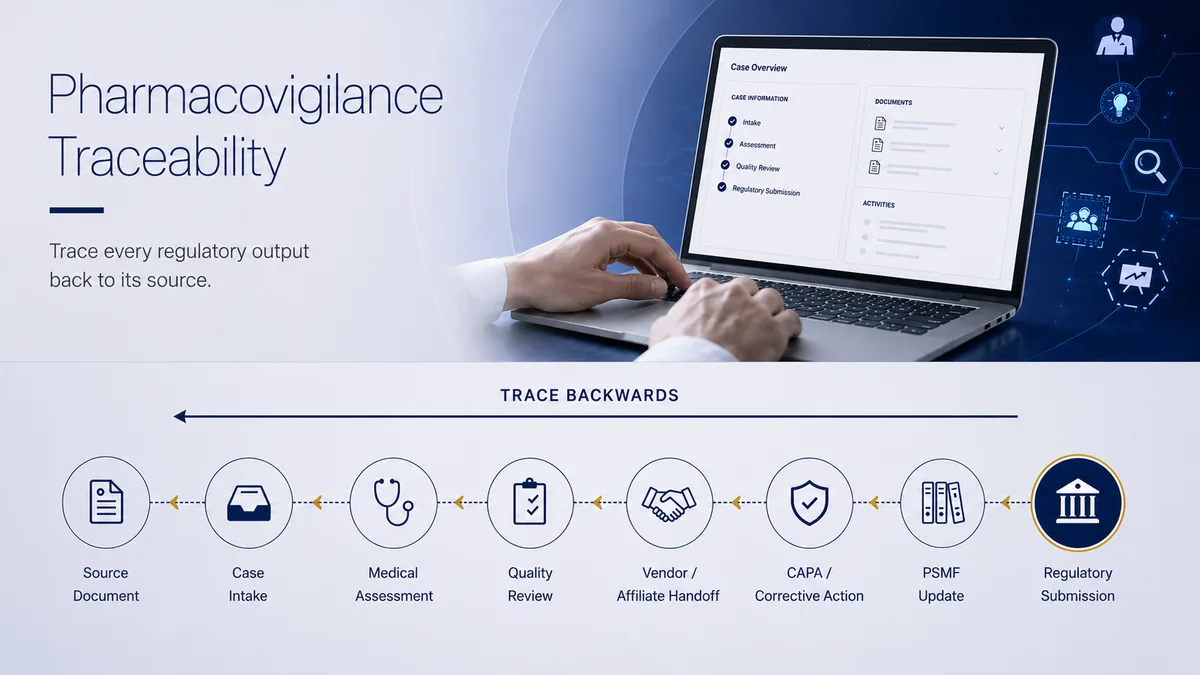
The Central Test: Can the System Be Reconstructed?
A controlled pharmacovigilance system should be reconstructable.
The organization should be able to show what happened, when it happened, who was responsible, which procedure applied, what evidence supported the decision, and whether oversight was performed.
This becomes especially important in distributed PV models involving global teams, local affiliates, vendors, CROs, safety databases, and regulatory functions.
The more distributed the operating model, the more important traceability becomes.
How MAHs Should Prepare
MAHs should conduct internal traceback inspections before regulators do.
This can include selecting real examples and testing whether the evidence trail is complete:
- One clinical trial safety report traced from clinical study documentation back to source safety information
- One submitted serious ICSR traced back to first receipt
- One signal decision traced back to source data and medical rationale
- One vendor activity traced back to oversight and reconciliation records
- One CAPA traced from closure to effectiveness evidence
- One PSMF update traced back to the operational change that triggered it
- One audit finding traced through root cause, corrective action, and follow-up
This approach helps identify operational weaknesses before they become inspection findings. It also strengthens confidence that the PV system is not only documented but controlled.
Organizations can also support readiness through Pharmacovigilance Consulting, Regulatory Intelligence, GxP Audits, and targeted Training & Upskilling initiatives.
The stronger inspection readiness question is no longer only, "Are our SOPs current?"
It is, "Can we trace a real PV activity backwards and demonstrate that the system worked as described?"
Traceback inspections help reveal weaknesses that standard documentation checks may miss. They test the connection between procedure, execution, oversight, records, and regulatory output.
For MAHs, CROs, biotechnology companies, and relevant medical device teams where safety vigilance processes apply, this is where inspection readiness becomes more than document preparation.
It becomes system evidence.
How PVCON Consulting Supports Traceback Inspection Readiness
PVCON Consulting supports pharmaceutical, biotechnology, CRO, and medical device organizations through specialized services including GxP Audits, PV Audits, GCP Audits, Other GxP Audits, Pharmacovigilance Consulting, PV Quality Management System support, PvOIC services, Regulatory Intelligence, Medical Writing, Aggregate Report Writing, Clinical Safety Documents, RMP and REMS Writing, PSMF Management, and Training & Upskilling initiatives such as Training Matrix, Regulatory Compliance Training, PV Boot Camp, and Customized Learnings.
Our expertise helps organizations strengthen drug safety operations, improve inspection and audit readiness, and keep PSMF documentation compliant, accurate, and aligned with real-world PV system practices and regulatory expectations.
If you are testing your PV system's traceability or preparing for an inspection, you can contact our team or learn more about us.