Read-and-Understand SOP Training in Pharmacovigilance
SOP acknowledgment records show completion, not practical competence. Learn how PV teams can build role-based, assessment-led training systems.

Why Read-and-Understand SOP Training Is Not Enough in Pharmacovigilance
A pharmacovigilance training matrix may appear complete. Every applicable SOP has been assigned, completion dates have been recorded, and acknowledgment records are available for review.
However, during a quality review or inspection interview, an employee may still struggle to apply the procedure to a real case. They may understand the wording of the SOP but remain uncertain about whether a case is valid, when it should be escalated, or which reporting timeline applies.
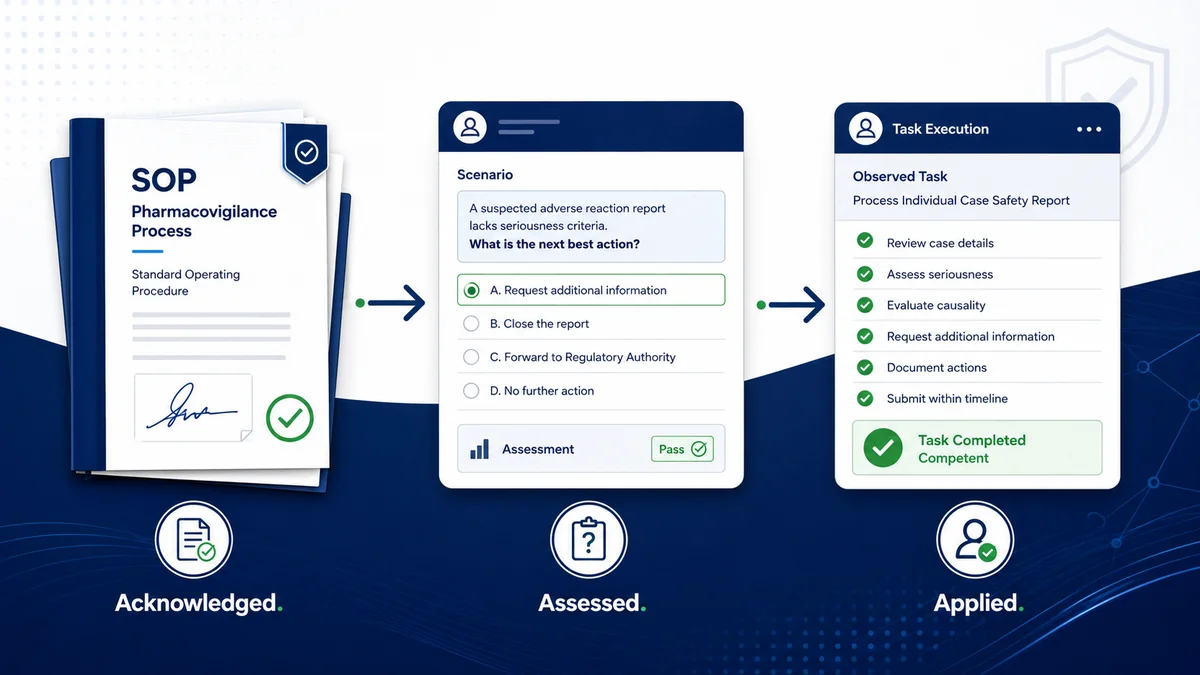
This is where the distinction between documented completion and demonstrated competence becomes important. An SOP acknowledgment record confirms that the assigned document was reviewed and acknowledged, but it does not independently demonstrate that the employee can apply the procedure correctly.
Key Takeaway
An SOP acknowledgment record is one component of a controlled training system, not complete evidence of competence. Effective training should connect the employee's responsibilities, the applicable procedure, the level of operational risk, the selected learning method, and appropriate evidence that the employee can understand and apply the procedure.
What Read-and-Understand SOP Training Actually Demonstrates
An SOP acknowledgment record can document who was assigned a controlled procedure, when the acknowledgment was recorded, and which SOP version applied. These details support document control and training traceability.
The limitation arises when acknowledgment is treated as evidence that the employee can perform the associated task. Reading a procedure may support awareness, but it may not be sufficient when the activity involves judgment, interpretation, system use, or regulatory decision-making.
Why the Difference Becomes Visible During an Inspection
The MHRA explains that GPvP inspections may include personnel interviews, document review, record requests, and demonstrations of computerized pharmacovigilance systems (MHRA GPvP inspection guidance).
Inspectors can compare documented training with operational understanding. A matrix may show full completion, while an interview reveals that personnel interpret the same criteria differently, follow an outdated workflow, or cannot explain an escalation route.
The impact can extend beyond an inadequate interview response. Inconsistent application of a procedure may contribute to delayed case processing, incorrect regulatory reporting decisions, incomplete escalation, recurring quality-control findings, or reduced confidence in the control of the PV system. The concern becomes greater when an acknowledgment record is the only evidence supporting a task that requires judgment or practical execution.
Match the Training Method to the Activity
Not every SOP requires a quiz, simulation, or observed assessment. The method should be proportionate to the complexity and potential impact of the task.
| Training level | Suitable use | Possible evidence |
|---|---|---|
| Acknowledgment | Administrative or low-impact content | R&U record |
| Understanding | Procedures involving defined decisions | Knowledge check or scenario discussion |
| Application | Safety-critical or judgment-based work | Case exercise, supervised review, or observation |
Consider two different SOP updates. The first corrects formatting, terminology, or a document reference without changing how the work is performed. A documented acknowledgment may be proportionate in this situation.
The second changes the criteria for case validity, expedited reporting, or safety escalation. If the revised requirement is misunderstood, the consequences could include delayed submissions, inconsistent case decisions, or regulatory noncompliance. In this situation, a scenario-based assessment, supervised case review, or practical demonstration may provide more meaningful evidence of understanding.
The learning method should therefore reflect the activity being performed. A representative case exercise may provide stronger evidence of readiness than a generic recall-based questionnaire.
Build the Pharmacovigilance Training Matrix Around Roles and Tasks
A controlled training matrix should begin with the work performed by each role, not with a master list of every SOP.
Two employees in the same department may have different responsibilities. Assigning the same curriculum to both can create unnecessary training without demonstrating role-specific readiness.
To reduce this risk, the training matrix should be built around the decisions and activities performed by each role. A case processor, quality reviewer, medical reviewer, and safety-system administrator may work within the same PV function, but each role requires different procedures, learning methods, and evidence of readiness.
The matrix should connect each role to the task, controlled procedure, training method, assessment requirement, and retraining trigger. It should also account for non-PV personnel whose activities may affect the pharmacovigilance system, including medical information, product complaints, regulatory affairs, clinical operations, and commercial functions.
A structured Training Matrix and Content Development approach can keep learning focused on actual responsibilities rather than document volume. PVCON's training services include regulatory-aligned matrices, role-based learning plans, assessments, and competency frameworks.
Treat SOP Changes as Training Impact Triggers
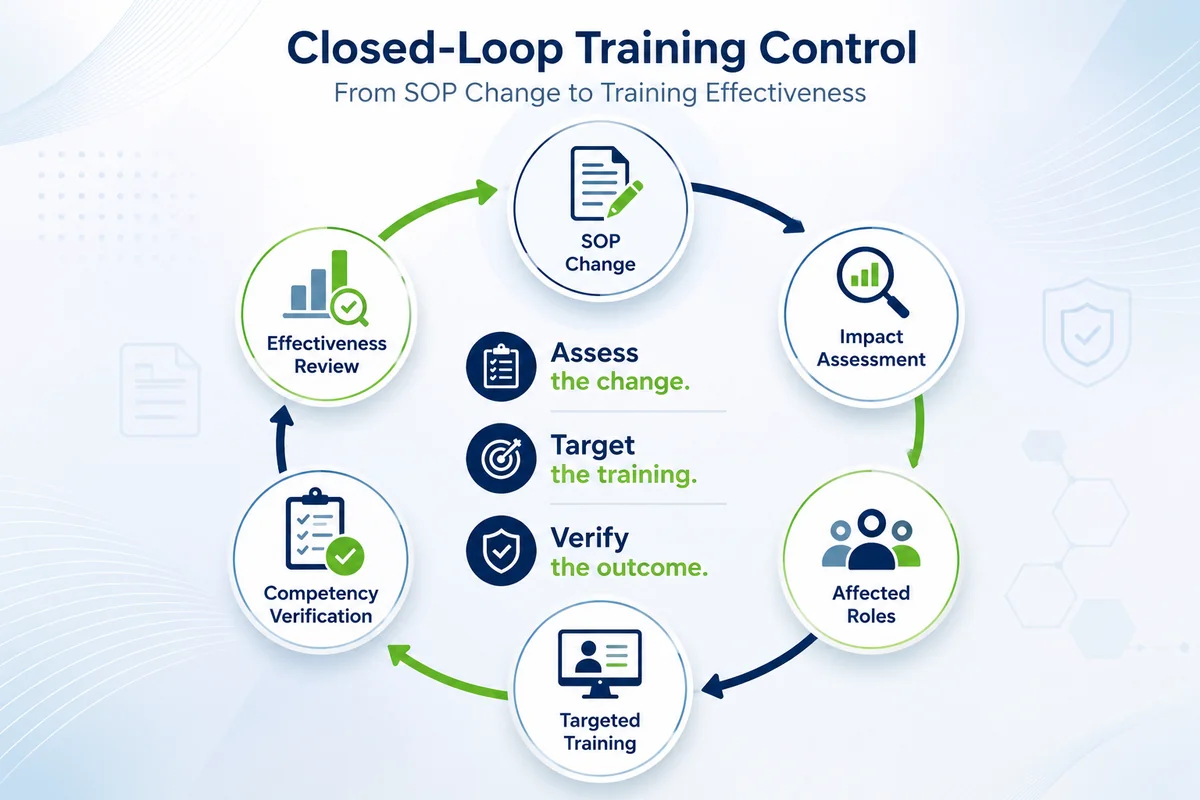
When an SOP changes, the first question should not simply be whether the revised document has been assigned. The organization should determine whether the change affects a task, decision criterion, system step, responsibility, reporting timeline, or escalation pathway.
For example, an editorial correction may require only documented acknowledgment. A change to a case-processing workflow may require targeted retraining, a knowledge assessment, or supervised application before personnel begin working independently under the revised process.
The training impact assessment should document what changed, which roles are affected, the level of operational or regulatory risk, and the evidence required to confirm readiness.
Training should also be reviewed when recurring quality-control errors, relevant deviations, role changes, inspection findings, or regulatory updates indicate that current knowledge may no longer be sufficient.
However, retraining should not become the default corrective action for every issue. If the actual cause is an unclear procedure, unsuitable system design, excessive workload, incomplete guidance, or undefined ownership, repeating the same training may not prevent recurrence. The corrective measure should address the underlying cause.
From Completion Records to Training Control
A completed training matrix may show that required learning activities took place. A controlled training system should go further by showing why the training was required, which task it supported, which document version applied, how the learning was delivered, and whether personnel demonstrated an appropriate level of understanding.
The objective is not to replace every SOP acknowledgment with a formal assessment. It is to use acknowledgment where it is proportionate and introduce stronger learning and verification methods where incorrect application could affect patient safety, data quality, regulatory reporting, or confidence in the control of the PV system.
Read-and-understand SOP training is not inherently unsuitable. Its value depends on where it is used and what the organization claims it proves.
How PVCON Consulting Supports Training Control
PVCON Consulting supports life sciences organizations through Training and Upskilling and GxP Auditing Services that evaluate whether documented training controls align with operational practice.
PVCON Consulting supports pharmaceutical, biotechnology, CRO, and medical device organizations through specialized services including GxP Audits, PV Audits, GCP Audits, Other GxP Audits, Pharmacovigilance Consulting, PV Quality Management System support, PvOIC services, Regulatory Intelligence, Medical Writing, Aggregate Report Writing, Clinical Safety Documents, RMP and REMS Writing, PSMF Management, and Training & Upskilling initiatives such as Training Matrix, Regulatory Compliance Training, PV Boot Camp, and Customized Learnings.
Our expertise helps organizations strengthen drug safety operations, improve inspection and audit readiness, and keep PSMF documentation compliant, accurate, and aligned with real-world PV system practices and regulatory expectations.
If you are reviewing your training matrix or strengthening evidence of role-specific competence, you can contact our team or learn more about us.