Risk-Based PV Audit Planning and Audit Readiness
Learn how risk-based PV audit planning supports audit readiness, vendor oversight, CAPA review, PSMF alignment, and documented pharmacovigilance audit strategy.
Risk-Based PV Audit Planning: Why the Audit Plan Must Be Supported by Risk Logic
A pharmacovigilance audit plan may look complete because it lists audits, dates, functions, affiliates, vendors, and expected timelines. However, an audit calendar alone does not prove that the audit programme is risk-based.
The stronger question is: why were those areas selected?
EMA GVP Module IV expects pharmacovigilance audits to follow a risk-based approach, with risk considered at strategic, tactical, and operational levels. Audit planning should therefore be supported by documented risk logic, not only recurring schedules (EMA GVP Module IV).
An audit calendar may support planning, but it does not, by itself, demonstrate a risk-based pharmacovigilance audit programme.
For MAHs, CROs, affiliates, and vendors, risk-based PV audit planning should explain why certain systems, processes, products, territories, or partners require audit attention now.
Key Takeaway
A PV audit plan shows what the organisation intends to audit. A strong PV audit risk assessment explains why those audits matter, why the timing is justified, and whether the audit programme reflects the current pharmacovigilance system. Without documented risk logic, audit planning may become a calendar exercise rather than a risk-based control.
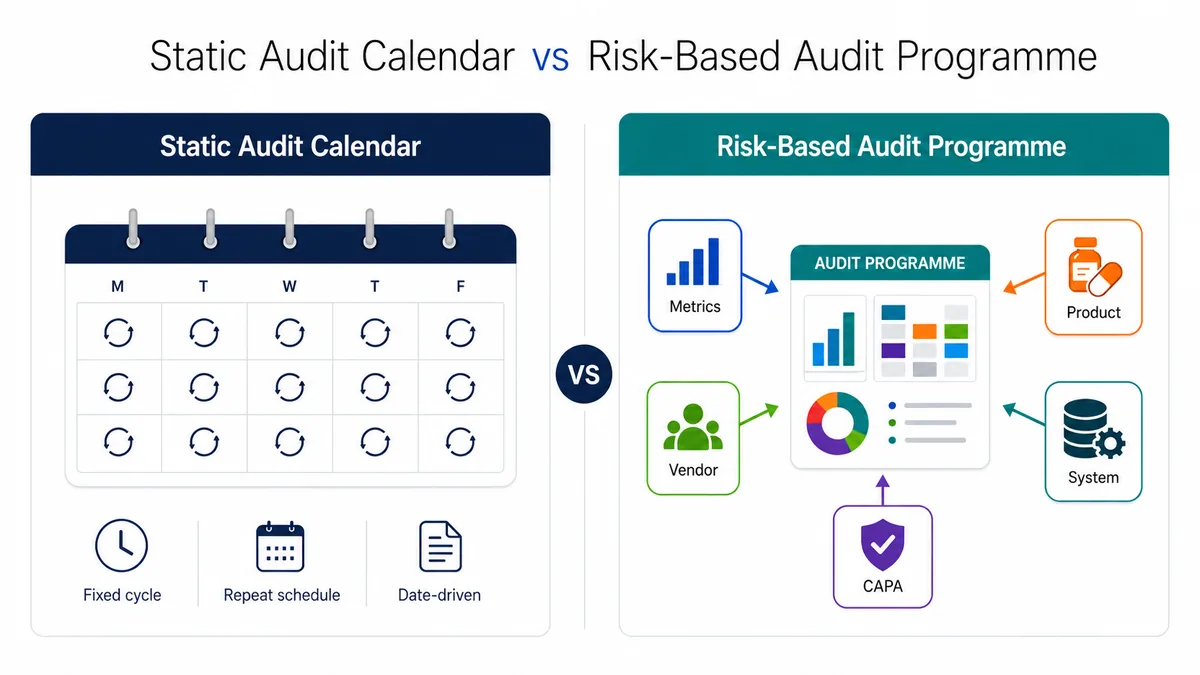
Why an Audit Calendar Alone Does Not Demonstrate a Risk-Based Audit Programme
Many organisations prepare annual audit calendars based on prior cycles. The same vendors, affiliates, or processes may be audited every two or three years because "that is the schedule."
This approach may support planning, but it does not demonstrate risk-based audit logic by itself.
A strong pharmacovigilance audit programme should respond to current system risk. That includes changes in products, safety databases, vendors, affiliates, CAPA status, compliance metrics, inspection outcomes, and regulatory requirements.
Organizations strengthening PV audit readiness should assess whether the audit programme reflects the live PV system, not only historical audit frequency.
What GVP Module IV Expects
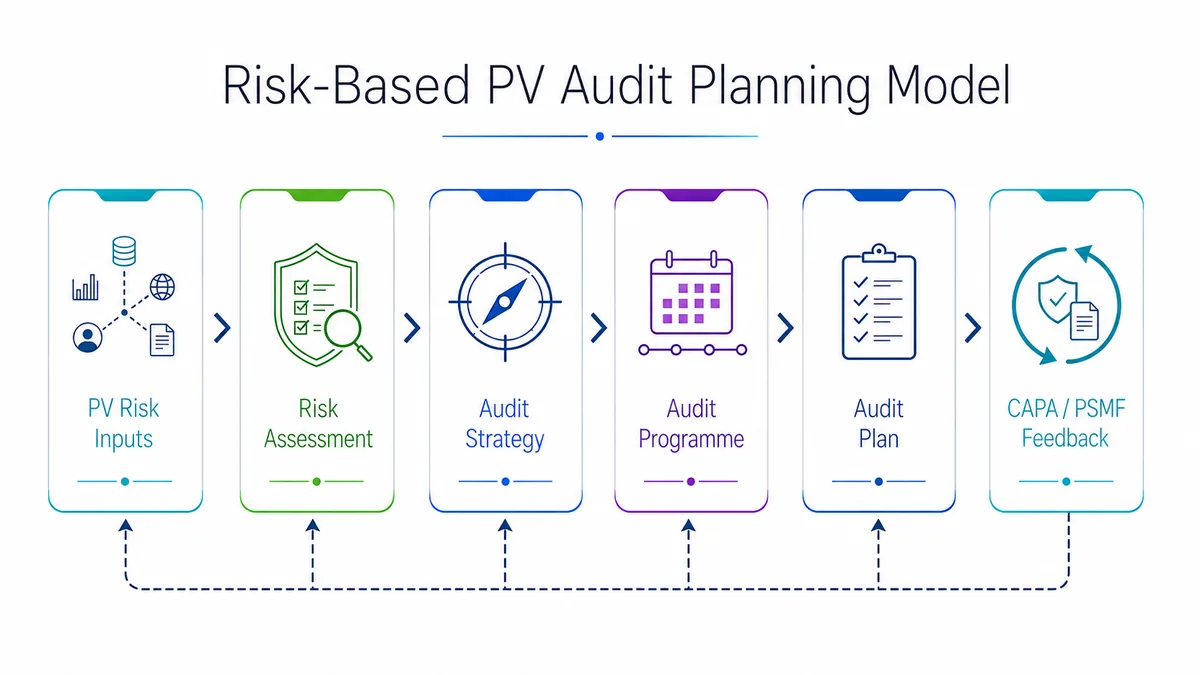
GVP Module IV separates audit planning into three levels:
| Audit Level | What It Should Explain |
|---|---|
| Strategic audit strategy | The audit universe, long-term audit approach, and risk-based coverage |
| Tactical audit programme | Which audits are selected for the period and why |
| Operational audit plan | How the individual audit scope, sampling, and testing are risk-based |
This distinction matters. A weak risk assessment may produce a calendar, but not a defensible audit programme.
For example, an individual vendor audit may be scheduled because the vendor is "due." A stronger approach asks whether the vendor handles critical PV activities, manages high case volume, supports ICSR reporting, has repeat deviations, recently changed systems, or has unresolved CAPA.
Where PV Audit Risk Assessments Become Too Generic
Weak risk assessments are rarely blank. More often, they are too generic.
| Weak Audit Planning | Risk-Based Audit Logic |
|---|---|
| Same audit cycle repeated annually | Audit scope adjusted based on current PV risk |
| Vendor audits based only on last audit date | Vendor audits based on criticality, performance, CAPA, and case volume |
| Safety database changes not reflected | System changes trigger risk reassessment |
| CAPA closure treated as final | CAPA effectiveness influences future audit priority |
| Local affiliates grouped together | Affiliate risk assessed by activity, product, territory, and compliance history |
These limitations can create a false sense of control. The audit calendar exists, but the audit programme may not be focused on the areas of highest current PV risk.
Risk Inputs That Should Influence Audit Coverage
A practical PV audit risk assessment should consider grouped risk inputs, not isolated indicators.
Operational risk inputs may include compliance metrics, ICSR timeline trends, workload changes, training gaps, and safety database updates.
Governance risk inputs may include previous audit findings, unresolved CAPA, repeat deviations, inspection outcomes, and management review outputs.
External and delegated activity inputs may include vendor performance, affiliate responsibilities, local regulatory expectations, product risk profile, and changes to outsourced PV activities.
This connection between audit evidence and quality system governance is where PV Quality Management System support is typically most valuable. GVP Module I also links audits, compliance monitoring, CAPA, management review, and quality-system effectiveness (EMA GVP Module I).
Vendor and Affiliate Risk Should Be Tiered
Vendor and affiliate risk should not be judged only by contract status or previous audit closure.
A medical information vendor, literature screening provider, local affiliate, call centre, safety database vendor, or outsourced case processing partner may each carry a different PV risk profile.
A stronger approach is to tier vendors and affiliates by criticality. For example, entities that affect ICSR timelines, case quality, regulatory submissions, patient safety, or MAH oversight should not be treated the same as lower-impact support providers.
Organizations reviewing delegated safety activities may use Pharmacovigilance Consulting support to assess whether partner oversight and audit prioritisation remain aligned with current operational risk.
Audit Findings Should Feed the Next Risk Assessment
A risk-based audit programme should learn from its own findings.
If an audit identifies repeat late reporting, weak reconciliation, incomplete training, inadequate vendor oversight, or ineffective CAPA, those findings should influence future audit priority. CAPA closure should not automatically reduce risk unless effectiveness evidence shows that the issue was corrected and did not recur.
If audit findings do not influence the next risk assessment, the audit programme may not be adequately using its own evidence.
The same logic applies to PSMF Management. GVP Module II identifies the PSMF as a basis for audit and inspection, which means audit findings, CAPA status, and system changes should remain traceable within the broader PV system description (EMA GVP Module II).
Strengthening PV Audit Readiness
A stronger PV audit programme starts with a clear audit universe, current risk inputs, defined scoring logic, documented rationale for audit selection, and regular reassessment when system conditions change.
The objective is not to audit everything more often. The objective is to audit the right areas at the right time, with scope and sampling that reflect real PV risk.
How PVCON Consulting Supports Risk-Based Audit Planning
PVCON Consulting supports organisations in strengthening PV audit strategy, vendor oversight, PV QMS governance, Regulatory Intelligence, and PSMF alignment. This helps audit planning move beyond calendar maintenance and become a stronger control for inspection preparedness, system oversight, and pharmacovigilance quality.
PVCON Consulting supports pharmaceutical, biotechnology, CRO, and medical device organizations through specialized services including GxP Audits, PV Audits, GCP Audits, Other GxP Audits, Pharmacovigilance Consulting, PV Quality Management System support, PvOIC services, Regulatory Intelligence, Medical Writing, Aggregate Report Writing, Clinical Safety Documents, RMP and REMS Writing, PSMF Management, and Training & Upskilling initiatives such as Training Matrix, Regulatory Compliance Training, PV Boot Camp, and Customized Learnings.
Our expertise helps organizations strengthen drug safety operations, improve inspection and audit readiness, and keep PSMF documentation compliant, accurate, and aligned with real-world PV system practices and regulatory expectations.
If you are strengthening your PV audit programme or preparing for an inspection, you can contact our team or learn more about us.