PV Agreements and SDEA Reconciliation
Learn how PV agreements and SDEAs affect reconciliation, ownership, transfer timelines, MAH oversight, and pharmacovigilance audit readiness.
PV Agreements and SDEA Reconciliation: Why Safety Data Exchange Raises PV Audit Concerns
PV agreements define how pharmacovigilance responsibilities are allocated between MAHs and their affiliates, partners, distributors, CROs, vendors, and service providers. An SDEA is a specific type of PV agreement focused on the exchange of safety information between parties.
These agreements may appear complete on paper. Audit concerns arise when auditors assess whether responsibilities are aligned and whether safety information was transferred, acknowledged, and reconciled as required.
EMA GVP Module VI expects contractual arrangements to be supported by explicit procedures and detailed agreements covering safety information exchange, timelines, regulatory submission responsibilities, and duplicate prevention.
The broader PV agreement establishes accountability and oversight, while the SDEA defines the operational requirements for safety data exchange. Reconciliation demonstrates whether those requirements are working in practice.
Key Takeaway
PV agreements define the broader allocation of pharmacovigilance responsibilities between parties, while SDEAs establish the specific requirements for exchanging safety information.
Audit concerns arise when these documents are inconsistent or are not supported by operational evidence. If timelines, ownership, case transfer rules, receipt confirmation, duplicate checks, reconciliation cycles, and escalation pathways are not tested against actual safety data, the agreements may remain documents rather than function as effective PV controls.
Where PV Agreements and SDEAs Raise Concerns During PV Audits
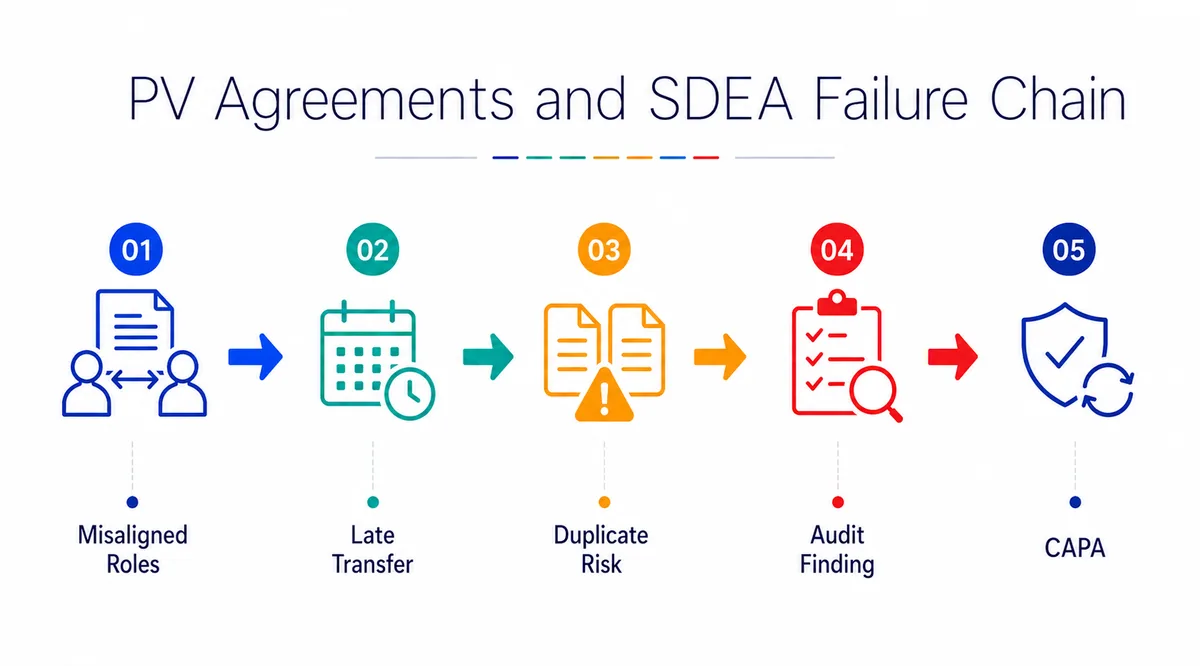
Weaknesses often appear where responsibility moves from one party to another or where the broader PV agreement does not align with the detailed requirements of the SDEA.
For example, a PV agreement may assign overall case management responsibility to the MAH, while the SDEA does not clearly define which information the partner must transfer, when the transfer timeline begins, or who must confirm receipt. Each party may believe the other has completed a required step, while reconciliation evidence may reveal gaps in ownership or execution.
| PV Agreement or SDEA Weakness | PV Audit Concern |
|---|---|
| Vague terms such as "promptly" or "without delay" | Day Zero and the expected transfer timeline cannot be consistently determined or measured |
| Different case IDs across systems | Case matching, duplicate detection, and ICSR reconciliation become difficult |
| No receipt confirmation | The MAH cannot demonstrate when safety information was received |
| Undefined follow-up ownership | Missing information may not be pursued or tracked consistently |
| Line listings without case-level checks | Completeness may be assumed rather than verified |
| Repeated discrepancies without CAPA | The issue is documented but not corrected |
These weaknesses may indicate broader concerns in PV Quality Management System support, vendor oversight, partner training, source data mapping, and audit preparedness.
The Timeline Trap
One of the most common SDEA risks is unclear timeline control.
EMA GVP Module VI defines Day Zero as the date on which information that meets the minimum criteria for a valid ICSR first becomes known to the competent authority or MAH. Reporting timelines are calculated in calendar days.
The risk increases when a partner receives safety information but the SDEA does not clearly define how quickly it must be transferred, how receipt is documented, and how the MAH confirms that reporting timelines have been protected.
A timeline that cannot be measured cannot be reconciled.
For example, an SDEA may say that serious cases should be transferred "as soon as possible." During a PV audit, this language is difficult to defend if there is no defined transfer requirement, timestamped acknowledgement, reconciliation log, or escalation record for late transfer.
Ownership Ambiguity Across PV Agreements and SDEAs
SDEA reconciliation often reveals differences between the responsibilities documented in the broader PV agreement and how each party interprets its operational role.
A distributor may believe the MAH owns case assessment after transfer. The MAH may assume the distributor has screened all local sources of safety information. A vendor may believe that only valid cases need to be shared, while the MAH may expect all potential safety information to be transferred for assessment.
This matters because MAH accountability remains in place even when pharmacovigilance activities are subcontracted. The broader PV agreement should define governance, oversight, and accountability, while the SDEA should translate those responsibilities into clear and measurable safety data exchange requirements.
Organizations reviewing outsourced or partner-led safety activities may use Pharmacovigilance Consulting to assess whether responsibilities are clearly defined, aligned, and supported by operational evidence.
Responsibilities should be aligned across both agreements for minimum criteria assessment, seriousness and reportability decisions, duplicate checks, follow-up, receipt confirmation, discrepancy escalation, reconciliation, and CAPA ownership.
What Auditors Ask for Beyond the Agreement
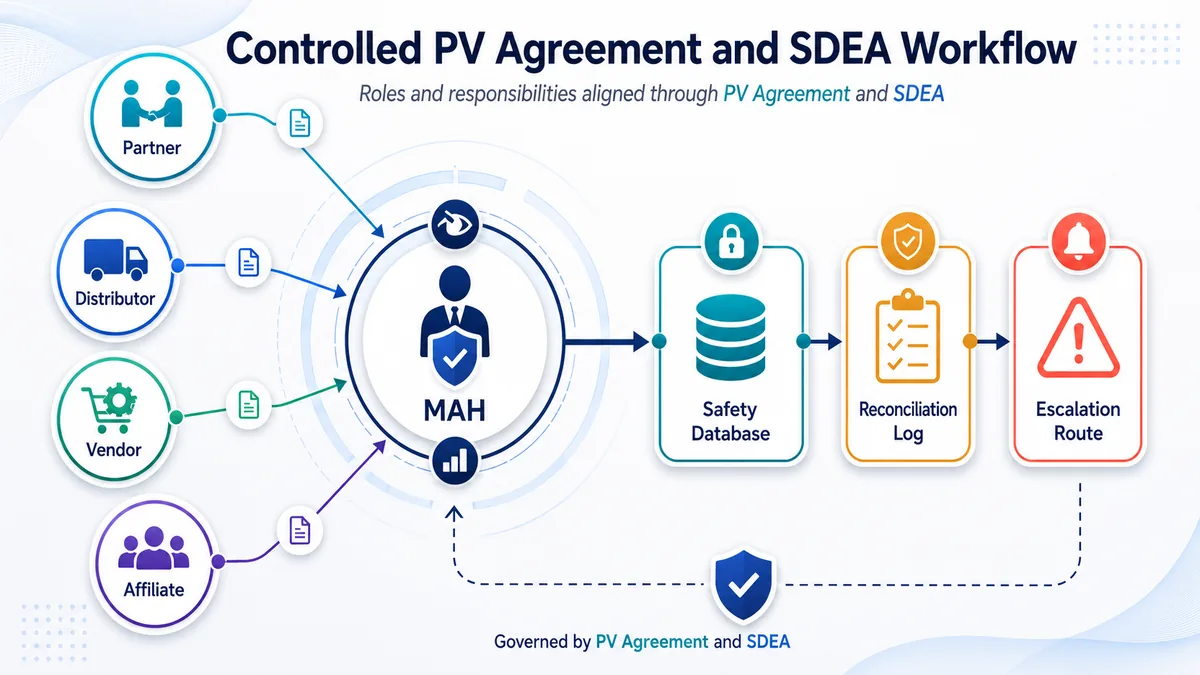
During a PV audit, auditors may first review the broader PV agreement and the SDEA to confirm that responsibilities, timelines, and escalation requirements are aligned. They will then assess the operational evidence.
Audit evidence usually falls into three categories:
- Agreement control: Current signed PV agreements and SDEAs, product and territory scope, version history, document hierarchy, and consistent allocation of responsibilities.
- Case-level evidence: Transfer logs, receipt acknowledgements, reconciliation records, discrepancy reports, duplicate checks, follow-up evidence, and case closure documentation.
- Governance evidence: Escalation records, partner training, oversight meetings, vendor or partner audit plans, CAPA documentation, and PSMF alignment.
This is where incomplete reconciliation can become a system-level weakness. EMA GVP Module II describes the PSMF as a basis for audits and inspections and notes that it provides a description of the pharmacovigilance system at the current time (EMA GVP Module II).
Where delegated activities, vendors, local responsibilities, or safety data sources change, PSMF Management should remain aligned with the live PV system.
How MAHs Should Test SDEA Readiness
SDEA readiness should be tested before an audit, not reconstructed during one.
MAHs should check whether both parties can demonstrate when safety information was first received, when it was transferred, who assessed validity, who determined reportability, how duplicates were handled, who owned follow-up, whether late or disputed cases were escalated, and whether repeated discrepancies were corrected.
This testing should include case-level sampling, reconciliation record review, deviation trending, and partner oversight assessment. Where appropriate, controlled mock reconciliation exercises using approved test records may help confirm whether transfer pathways, receipt confirmations, and escalation routes operate as intended.
The objective is not to make the agreement look complete. The objective is to demonstrate controlled safety data exchange.
Updating the SDEA Is Not Enough
When reconciliation findings arise, organizations often respond by updating the SDEA. This may be necessary, but it is rarely sufficient on its own.
Organizations should assess whether the broader PV agreement, the SDEA, supporting procedures, training, system configurations, and operational practices remain aligned. A structured PV Audit can help identify gaps between documented responsibilities and actual safety data exchange practices.
If the root cause is unclear ownership, inconsistent source screening, weak training, missing receipt evidence, or ineffective escalation, revising an agreement will not correct the underlying exchange control. Regulatory Intelligence can also help organizations keep their agreements and processes aligned with changing pharmacovigilance expectations.
The stronger CAPA question is whether responsibilities are now aligned across all applicable PV agreements and whether the next reconciliation confirms that the issue has been corrected.
Updated agreements define the expected control. Successful reconciliation demonstrates that the control is working.
How PVCON Consulting Supports SDEA and PV Audit Readiness
PVCON Consulting supports pharmaceutical, biotechnology, CRO, and medical device organizations through specialized services including GxP Audits, PV Audits, GCP Audits, Other GxP Audits, Pharmacovigilance Consulting, PV Quality Management System support, PvOIC services, Regulatory Intelligence, Medical Writing, Aggregate Report Writing, Clinical Safety Documents, RMP and REMS Writing, PSMF Management, and Training & Upskilling initiatives such as Training Matrix, Regulatory Compliance Training, PV Boot Camp, and Customized Learnings.
Our expertise helps organizations strengthen drug safety operations, improve inspection and audit readiness, and keep PSMF documentation compliant, accurate, and aligned with real-world PV system practices and regulatory expectations.
If you are reviewing your PV agreements or preparing for a PV audit, you can contact our team or learn more about us.