Signal Decisions in Pharmacovigilance
Learn why PV systems often show weakness in signal decisions, not case processing, and how strong signal governance supports GVP compliance and inspection readiness.

Most PV Systems Do Not Fail in Case Processing. They Fail in Signal Decisions
Case processing is visible and measurable. A case was received, assessed, followed up, processed, and submitted.
That matters, but it does not prove PV system maturity.
The harder test is whether the organization can interpret safety information, identify what matters, justify decisions, escalate concerns, and track outcomes. A PV system may process cases on time and still fail to explain why a signal was validated, deprioritised, escalated, closed, or converted into regulatory action.
Signal decisions are where pharmacovigilance moves from data handling to patient safety judgment.
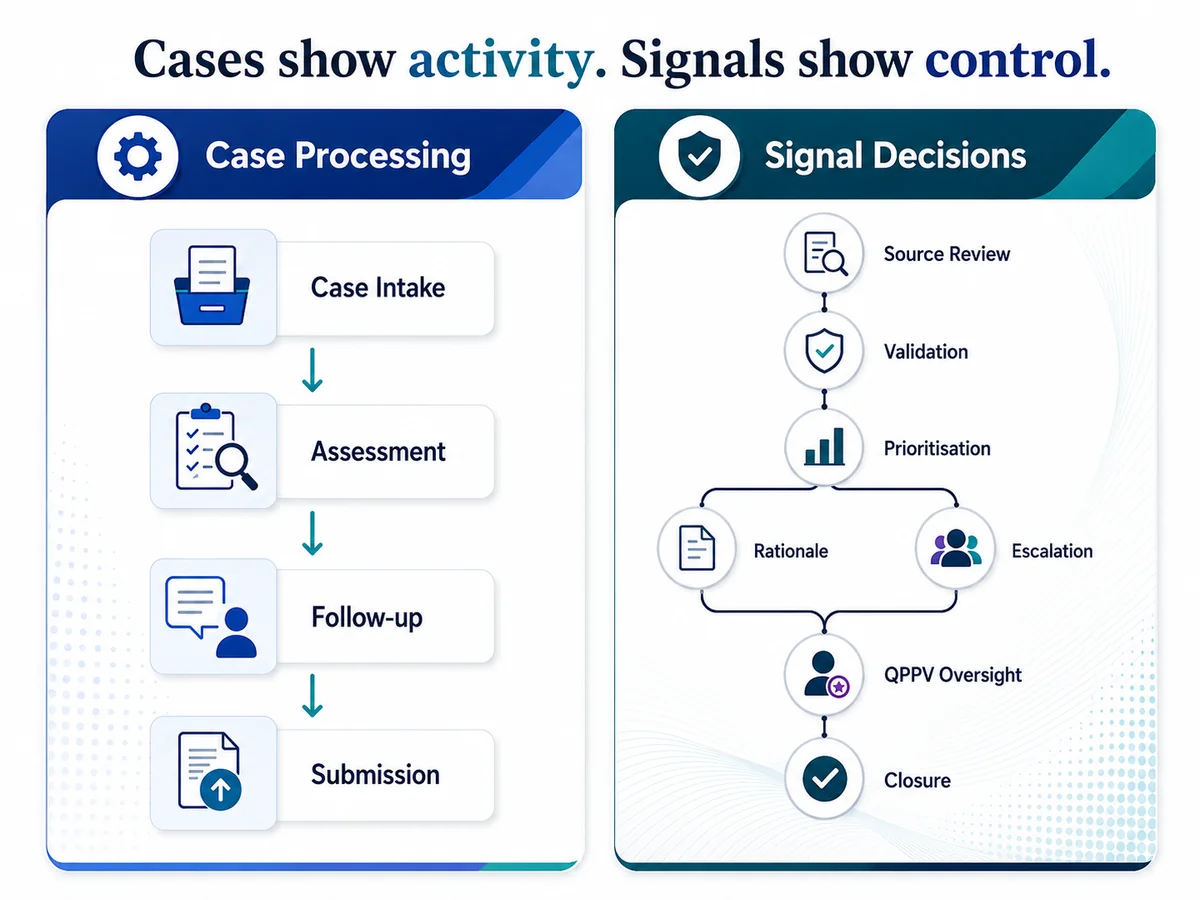
Case Processing Shows Activity. Signal Decisions Show Control.
Case processing asks: Was the case received, assessed, submitted on time, followed up, and completed?
Signal management asks: Was the pattern clinically meaningful? Were all relevant sources reviewed? Was the rationale clear? Was prioritisation risk-based? Was QPPV oversight visible? Was the outcome tracked?
EMA GVP Module IX covers detection, validation, confirmation, analysis and prioritisation, assessment, recommendation for action, communication, and tracking.
Case processing shows activity happened. Signal decisions show whether the organization understood what the activity meant.
Where Signal Decisions Start to Break Down
Signal weaknesses often appear in the decision trail, not the SOP or signal log.
Common weak points include:
- Validation decisions with weak clinical rationale
- Non-validation decisions that do not explain closure
- EudraVigilance data reviewed separately from other sources
- Delayed prioritisation of clinically relevant signals
- Informal escalation not reflected in records
- Signal closure without scientific or medical justification
- Limited QPPV visibility over higher-risk decisions
- No link between assessment and product information, RMP, PSUR, or regulatory action
These gaps affect whether the organization can defend its benefit-risk decision-making.
For example, a company may close a potential signal because report numbers appear low. But if the record does not show review of EudraVigilance data, literature, aggregate trends, medical plausibility, and product context, the issue is not only the conclusion. It is the missing rationale behind it.
EudraVigilance Makes Signal Governance More Visible
EudraVigilance monitoring should not sit as a separate data check. It should feed into the MAH's signal management process alongside case data, literature, aggregate reports, and medical input.
A weak signal file only shows that sources were reviewed. A strong signal file shows how those sources shaped the decision, including the trigger, EudraVigilance input, medical review, validation or non-validation rationale, prioritisation, QPPV visibility, recommended action, and closure status.
The Inspection Question Is: Can You Defend the Decision?
Signal detection is only the starting point. A signal may be detected but poorly validated, prioritised incorrectly, closed without enough rationale, or acted on without a clear evidence trail.
For inspection readiness, the organization should be able to show:
- What triggered the review
- Which sources were considered
- What scientific or medical rationale supported the decision
- Who reviewed and approved it
- Whether QPPV oversight was proportionate to risk
- Whether regulatory actions, product information, RMP, PSUR, or communication needs were considered
QPPV involvement should be defined by risk, especially for validated signals, urgent safety concerns, major benefit-risk questions, or decisions linked to regulatory action. Evidence should be visible in the signal record, meeting minutes, decision log, or governance tracker.
Third-Party Signal Monitoring Needs the Same Control
Many MAHs use vendors for case processing, literature screening, signal detection support, database activities, or safety operations. Accountability still remains with the MAH.
If a vendor supports signal management, the MAH should be able to show what is outsourced, which sources are reviewed, how signals are escalated, who validates or rejects them, how timelines are tracked, and how QPPV oversight is maintained.
Vendor output should support the decision, not replace MAH governance.
Is Your Signal Decision Process Inspection-Ready?
A readiness check should test whether signal decisions are consistent, traceable, timely, and scientifically defensible.
For recent validated, non-validated, closed, and actioned signals, ask:
- Is the trigger documented?
- Are all relevant sources listed?
- Is the rationale clear?
- Is prioritisation risk-based?
- Is medical review visible?
- Is QPPV oversight clear where relevant?
- Are actions tracked to closure?
- Are vendor inputs governed?
If the answers depend on memory, email trails, or informal explanations, the signal process is not inspection-ready enough.
How PVCON Consulting Supports Signal Management Readiness
Signal management is where pharmacovigilance moves from data handling to patient safety decision-making. The strength of the process depends on defined roles, scientific rationale, documented decisions, traceable records, and clear oversight.
PVCON Consulting supports pharmaceutical, biotechnology, CRO, and medical device organizations through specialized services including GxP Audits, PV Audits, GCP Audits, Other GxP Audits, Pharmacovigilance Consulting, PV Quality Management System support, PvOIC services, Regulatory Intelligence, Medical Writing, Aggregate Report Writing, Clinical Safety Documents, RMP and REMS Writing, PSMF Management, and Training & Upskilling initiatives such as Training Matrix, Regulatory Compliance Training, PV Boot Camp, and Customized Learnings.
Our expertise helps organizations strengthen drug safety operations, improve inspection and audit readiness, and keep PSMF documentation compliant, accurate, and aligned with real-world PV system practices and regulatory expectations.
If you are evaluating your signal management process or preparing for an inspection, you can contact our team or learn more about us.