Traceability in PV Inspection Readiness
Learn what traceability means in pharmacovigilance, why inspectors test it, and how PV teams can strengthen records, CAPA, QPPV oversight, vendor control, and inspection readiness.
Traceable Is Not a Buzzword. It Is What Inspectors Test First
The July 2025 EU GMP draft revisions brought ALCOA++ back into regulatory discussion, especially because "Traceable" is now more visible in documentation, computerized systems, audit trails, and data integrity language.
For pharmacovigilance teams, the important point is not that traceability is suddenly new. EMA GVP Module I already expects record management systems to support retrievability and traceability of safety concern investigations, timelines, decisions, dates, and decision-making processes.
What has changed is the pressure around proof.
Traceability can no longer sit in the background as an assumed principle. PV teams need to show that safety information, decisions, actions, and follow-up can be reconstructed clearly during audits and inspections.
The wider EU PV framework is also moving in the same direction. Commission Implementing Regulation (EU) 2025/1466, applicable from 12 February 2026, strengthens expectations around pharmacovigilance activities, including signal management, oversight, third-party control, and documented procedures.
So the real question is simple:
Can your PV system prove what happened, when it happened, who was responsible, why the decision was made, and what evidence supports it?
Traceability Means More Than Having Documents
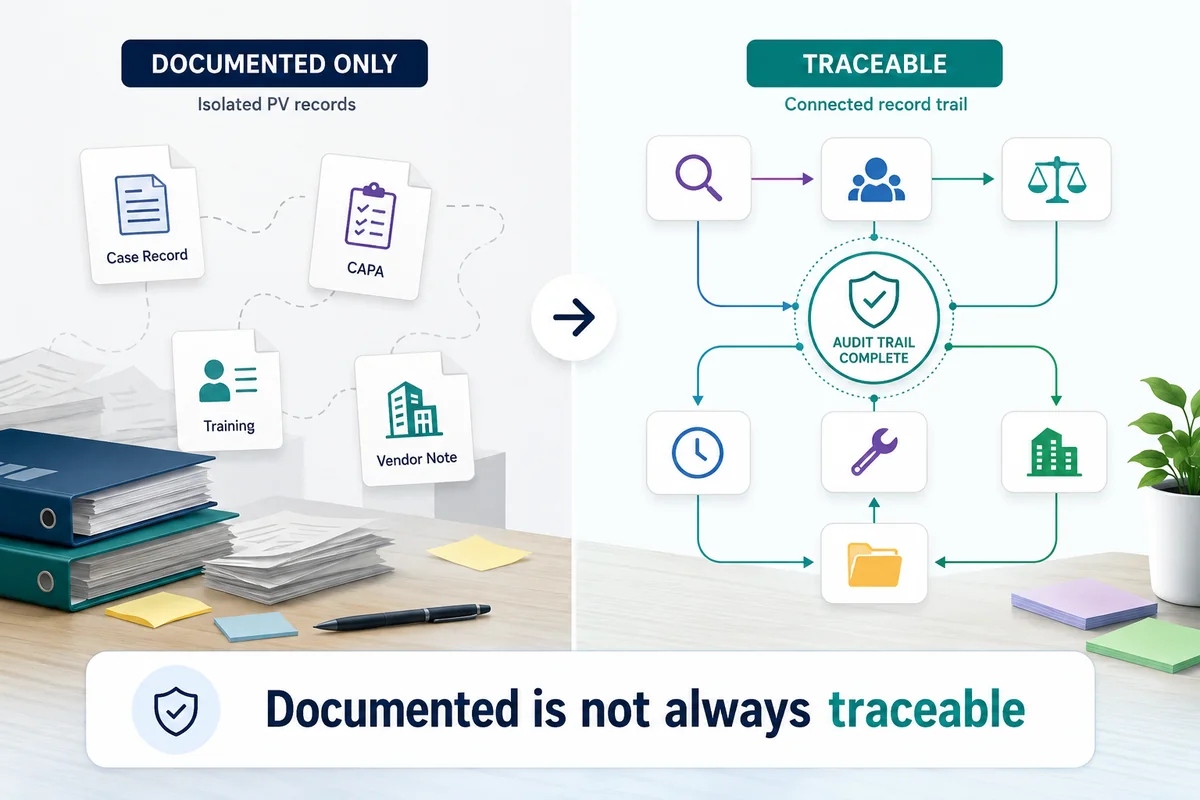
In pharmacovigilance, a document is not automatically traceable because it exists in a folder, shared drive, or system.
A traceable PV record should show:
- Where the information came from
- Who reviewed it
- What decision was made
- When the decision was made
- Why the decision was justified
- What follow-up action was taken
- Where the final evidence is stored
This applies across case processing, signal management, CAPA, vendor oversight, training, regulatory responses, PSMF maintenance, and QPPV oversight.
A safety decision without a documented rationale becomes difficult to defend. A CAPA closed without effective evidence looks weak. A vendor oversight record without issue history, escalation notes, audit rights, and follow-up evidence creates inspection risk.
This is why traceability is not a documentation style. It is inspection evidence.
Why Inspectors Care About the Trail
Inspectors do not only check whether an SOP exists. They test whether the SOP was followed through with real evidence.
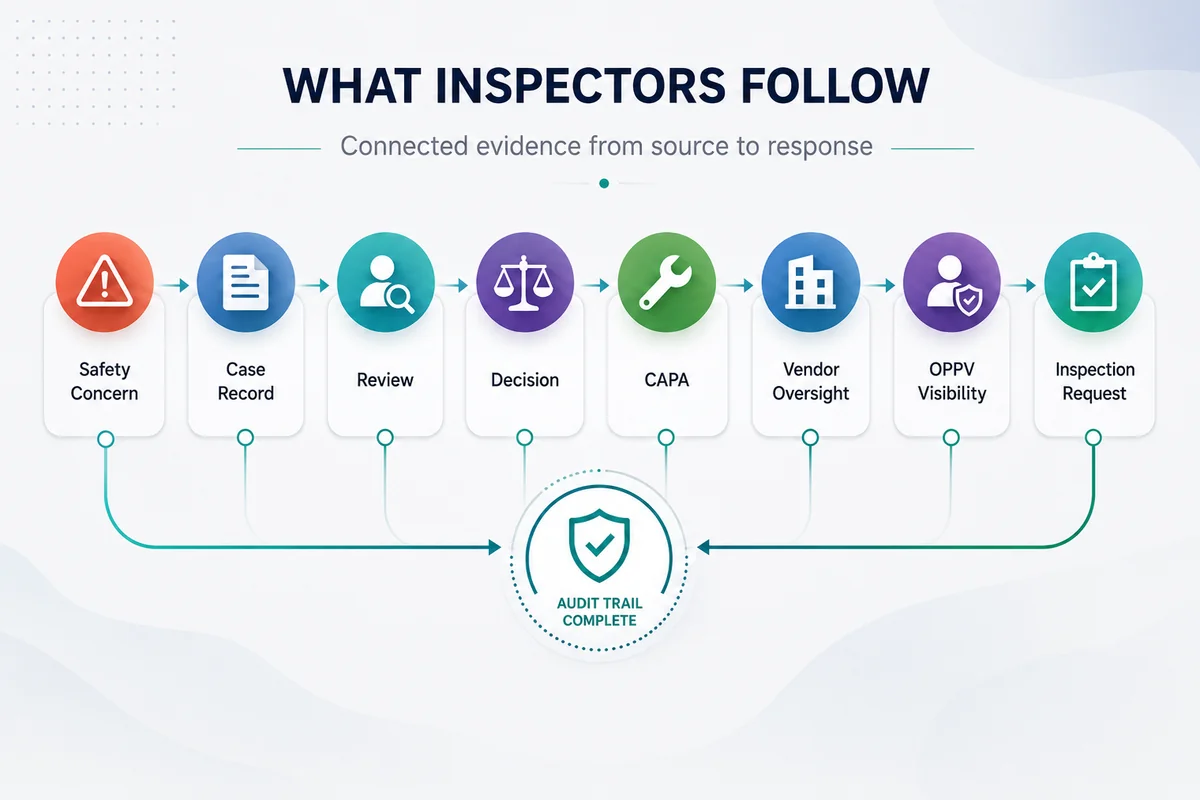
They may ask for a case history, signal decision, CAPA file, training record, vendor oversight record, QPPV access evidence, or PSMF update history. Then they follow the trail.
Common traceability weaknesses in PV include:
- Case records with a final decision but no clear rationale
- CAPAs closed without root cause linkage or an effectiveness check of evidence
- Vendor issues escalated informally but not captured in oversight records
- Training records that do not show role-based readiness
- Signal assessments that do not clearly show source data, review logic, and decision history
- PSMF updates that do not clearly connect system changes to documented evidence
The weak point is often not the final document. It is the gap between the source, review, decision, approval, and follow-up.
What "Traceable" Should Look Like in PV
A traceable PV record should answer six basic questions:
| Traceability Question | What Inspectors May Expect to See |
|---|---|
| Who acted? | Named owner, reviewer, approver, or responsible function |
| What was reviewed? | Source record, case data, signal output, vendor record, or CAPA file |
| When did it happen? | Clear dates, timestamps, timelines, and sequence of actions |
| Why was the decision made? | Documented rationale and supporting evidence |
| What action followed? | Follow-up, escalation, CAPA, closure, or monitoring |
| Where is the evidence? | Retrievable record location with version control where relevant |
This is where ALCOA++ becomes useful as a practical lens. ALCOA++ refers to Attributable, Legible, Contemporaneous, Original, Accurate, Complete, Consistent, Enduring, Available, and Traceable.
For PV teams, "Traceable" connects the rest of these principles into a usable inspection story. Attribution shows who performed an action. Traceability shows the full history around that action.
If the record is attributable but the decision history is unclear, the trail is incomplete. If the data is available but the rationale is missing, the trail is weak. If the CAPA is closed but the supporting evidence cannot be retrieved, the record may not stand up well during review.
How PV Teams Should Test Traceability Before Inspection
Audits and inspections are different, but both depend on traceability. A PV audit helps identify weaknesses in the pharmacovigilance system before they become regulatory issues. A PV inspection tests whether the organization can demonstrate control to regulators.
That is why traceability should be reviewed during routine quality oversight, not only before inspection. PV teams should check it across CAPA, vendor governance, signal management, training records, QPPV oversight, and digital workflows.
This is also important when digital or AI-supported tools are used for case intake, literature screening, signal detection, or documentation. Teams should be able to trace the output back to the source data, review logic, human decision, and documented follow-up.
A simple internal test can help. Pick one safety concern, one CAPA, one vendor issue, one signal decision, and one training record. For each, ask:
- Can the source record be retrieved quickly?
- Is the decision rationale documented?
- Are dates, reviewers, approvals, and actions clear?
- Is QPPV oversight visible where relevant?
- Are vendor roles, responsibilities, and escalation points documented?
- If digital tools are used, can the output be traced back to source data and human review?
If the answer is no, the issue is not only administrative. It is a control weakness.
How PVCON Consulting Supports Traceability Readiness
Traceability depends on clear systems, defined responsibilities, controlled documentation, and evidence that can be retrieved when needed.
PVCON Consulting supports pharmaceutical, biotechnology, CRO, and medical device organizations through specialized services including GxP Audits, PV Audits, GCP Audits, Other GxP Audits, Pharmacovigilance Consulting, PV Quality Management System support, PvOIC services, Regulatory Intelligence, Medical Writing, Aggregate Report Writing, Clinical Safety Documents, RMP and REMS Writing, PSMF Management, and Training & Upskilling initiatives such as Training Matrix, Regulatory Compliance Training, PV Boot Camp, and Customized Learnings.
Our expertise helps organizations strengthen drug safety operations, improve inspection and audit readiness, and keep PSMF documentation compliant, accurate, and aligned with real-world PV system practices and regulatory expectations.
If you are evaluating your pharmacovigilance system or preparing for an inspection, you can contact our team or learn more about us.