UK vs EU Pharmacovigilance Training | Global PV Guide
Compare MHRA and EMA GVP training expectations and build a practical, role-based upskilling roadmap for global pharmacovigilance teams.
UK vs EU Pharmacovigilance Training: What Global PV Teams Need to Know
"The UK retained EU GVP after Brexit, so our existing training covers both markets."
That conclusion is understandable, but incomplete.
The UK continues to use Good Pharmacovigilance Practices as an important regulatory foundation. Core concepts such as individual case safety reporting, signal management, risk management and pharmacovigilance system oversight therefore remain familiar.
Operational requirements have nevertheless diverged. Global safety teams must apply different regulatory routes, product categories, authority procedures and system-documentation requirements. The Windsor Framework added another layer from 1 January 2025.
The UK vs EU pharmacovigilance training challenge is not about choosing between GVP and a completely different UK framework. It is about teaching personnel where a common foundation leads to different operational actions.
Key Takeaway
UK and EU pharmacovigilance training share the same core expectation: personnel require initial and continued learning appropriate to their responsibilities.
Global teams also need jurisdiction-specific training where UK and EU requirements differ, particularly for reporting routes, product categorisation, PSMF arrangements and authority interactions.
Are UK and EU Training Requirements Fundamentally Different?
Not at the foundational level.
EU GVP requires organisations to maintain a pharmacovigilance quality system supported by appropriately qualified and trained personnel. Training must relate to assigned responsibilities and remain documented.
The MHRA also applies GVP principles alongside UK legislation and published modifications. Its Good Pharmacovigilance Practice guidance confirms that UK MAHs and service providers may be inspected against UK pharmacovigilance obligations.
| Training layer | Shared or separate? | Typical content |
|---|---|---|
| Core PV principles | Largely shared | ICSR, signal and risk management |
| Regulatory framework | Jurisdiction-specific | EU legislation or UK guidance |
| Operational procedures | Jurisdiction-specific | Submissions and authority communications |
| Product requirements | Product-specific | UK category and EU authorisation route |
| Role application | Role-specific | Tasks performed by each function |
Global programmes can retain a common core, but they cannot stop there.
Where Has UK Pharmacovigilance Diverged?
Regulatory Roles and Availability
An EU QPPV must reside and operate in the EU/EEA. For UK-authorised products, the UK QPPV may reside and operate in the UK or EU/EEA.
The same individual may perform both roles when the applicable conditions are met.
If the UK QPPV resides and operates in the EU/EEA, the MAH must appoint a UK National Contact Person for Pharmacovigilance. This person must reside and operate in the UK, report to the QPPV and facilitate responses to MHRA queries and inspections.
These arrangements are explained in the MHRA guidance on QPPV and PSMF requirements.
Training must define responsibilities, escalation routes, availability expectations and regulatory communication pathways.
ICSR and Regulatory Submission Routes
Case-processing teams require more than general ICSR training. They need product- and territory-specific decision logic.
Since 1 January 2025, reporting requirements depend on the UK product category, event location and whether the company holds a corresponding EU/EEA licence. The MHRA's Windsor Framework pharmacovigilance guidance outlines the applicable scenarios.
Training that describes only EudraVigilance submission cannot prepare personnel to apply this logic correctly.
PSMF Arrangements
All UK marketing authorisations require coverage by a UK PSMF. Each pharmacovigilance system covering UK-authorised products requires a unique MHRA-issued UK PSMF number.
The address from which the PSMF can be accessed electronically must be in the UK.
Personnel responsible for the file must understand its registration, accessibility, maintenance and requirements for producing it during an inspection. Training should also identify changes requiring procedural, system or regulatory updates.
The Windsor Framework
The Windsor Framework introduced Category 1 and Category 2 product classifications from 1 January 2025.
These categories affect ICSR reporting, PSUR submissions, post-authorisation safety studies, safety referrals and the implementation of EU outcomes.
Category 1 products primarily follow UK pharmacovigilance requirements. Category 2 products remain subject to specified EU requirements alongside UK obligations.
Training must therefore connect product categorisation with operational decisions rather than treating the Windsor Framework as awareness content alone.
Which Teams Need Jurisdiction-Specific Upskilling?
Not every employee requires the same regulatory depth.
| Role group | Jurisdiction-specific learning |
|---|---|
| QPPV and UK National Contact Person | Authority interfaces, availability and escalation |
| Case-processing teams | Destination, timelines and duplicate prevention |
| Signal and benefit-risk teams | MHRA and EMA processes and data sources |
| PSMF owners | UK and EU file arrangements and change control |
| Regulatory and medical-writing teams | PSUR, RMP, PASS and referral procedures |
| Affiliates and vendors | Local routes and contractual responsibilities |
| Quality and training teams | Curriculum governance and inspection evidence |
For German and DACH affiliates, the local Schulungsmatrix may use German terminology and materials. However, localisation must extend beyond translation. The matrix should connect each role to the EU activities performed and any UK-facing responsibilities supported.
A Practical Cross-Border Upskilling Roadmap
Start by mapping products, authorisations and territories. Confirm which products fall within Category 1 or Category 2 and identify corresponding EU licences.
Next, map personnel to activities rather than job titles alone. Determine who processes cases, maintains system documentation, monitors regulatory changes and communicates with authorities.
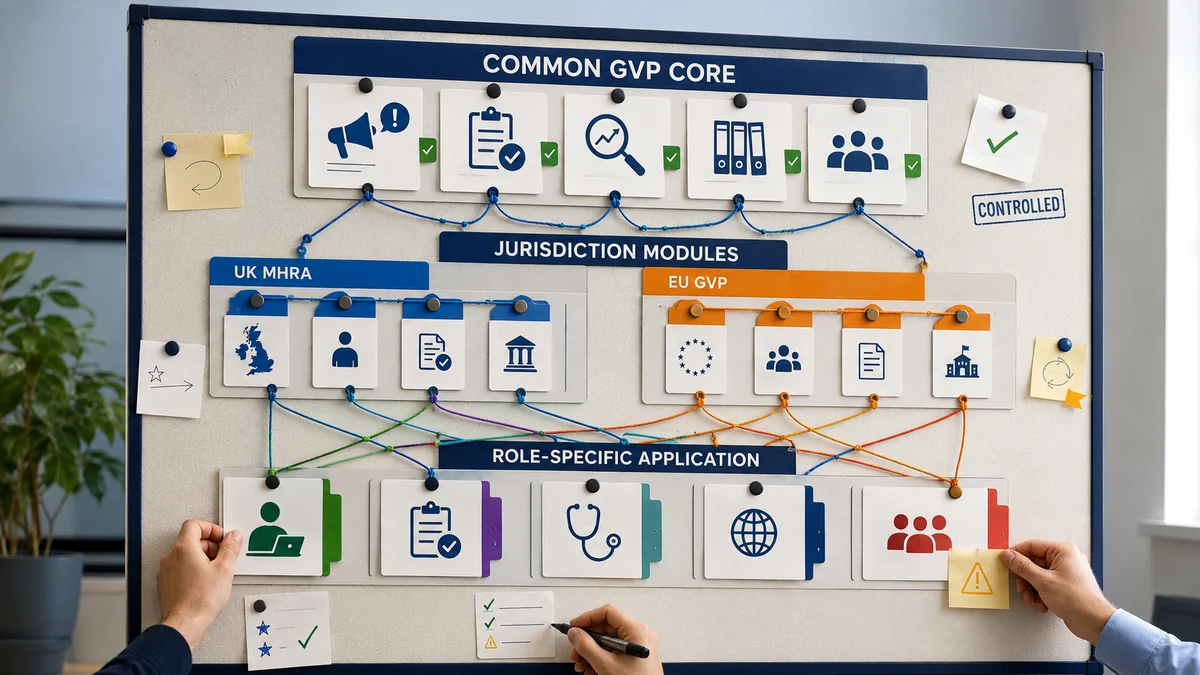
Build three training layers:
- A shared GVP core covering common principles.
- A UK or EU module covering divergent requirements.
- Role-based PV training that converts those requirements into controlled tasks.
Align the curriculum with SOPs, working instructions, safety agreements and the training matrix. A regulatory update does not become operational until procedures, learning content and role assignments agree.
Test Operational Competence
Completion records confirm attendance. Scenario testing provides stronger evidence that personnel can apply the training.
Present a case involving a UK event, a Category 2 product and a corresponding EU licence. Ask the learner to identify the submission destination, applicable timeline, governing procedure and escalation route.
Record the outcome and address incorrect decisions through targeted retraining. This converts regulatory knowledge into evidence of role-specific competence.
One Global Curriculum Is Not One Identical Curriculum
UK and EU pharmacovigilance share important principles, but shared origins do not create identical operating requirements.
A sustainable programme combines a common GVP foundation with jurisdiction-specific content and role-based instruction. It should also maintain a controlled divergence map so that regulatory changes flow into procedures, curricula, assessments and training records.
PVCON Consulting supports organisations through regulatory compliance training, role-based training matrix and content development and wider training and upskilling services.
PVCON Consulting supports pharmaceutical, biotechnology, CRO, and medical device organizations through specialized services including GxP Audits, PV Audits, GCP Audits, Other GxP Audits, Pharmacovigilance Consulting, PV Quality Management System support, PvOIC services, Regulatory Intelligence, Medical Writing, Aggregate Report Writing, Clinical Safety Documents, RMP and REMS Writing, PSMF Management, and Training & Upskilling initiatives such as Training Matrix, Regulatory Compliance Training, PV Boot Camp, and Customized Learnings.
Our expertise helps organizations strengthen drug safety operations, improve inspection and audit readiness, and keep PSMF documentation compliant, accurate, and aligned with real-world PV system practices and regulatory expectations.
To align your global training programme with current UK and EU requirements, you can contact our team or learn more about us.