Validated PV Systems and Inspection Readiness
Learn why validation alone does not prove PV system inspection readiness and how continuous control, audit trails, access governance, and change management support sustained compliance.
Your PV System Is Validated. But Is It Still Inspection-Ready?
Validation is an important milestone for any pharmacovigilance system. It confirms that the system was assessed against defined requirements and intended use at a specific point in time.
However, validation alone does not prove that the system remains inspection-ready.
Regulatory inspectors look beyond the validation certificate. They assess whether the system continues to operate under control during routine use. This includes how access is managed, whether audit trails are reviewed, how changes are controlled, how vendor updates are assessed, and whether system outputs remain aligned with approved SOPs.
A safety database, document management system, signal detection tool, literature screening platform, or vendor-managed workflow may be validated. However, if live system use has moved away from the validated process, the validation package may not be enough to support inspection readiness.
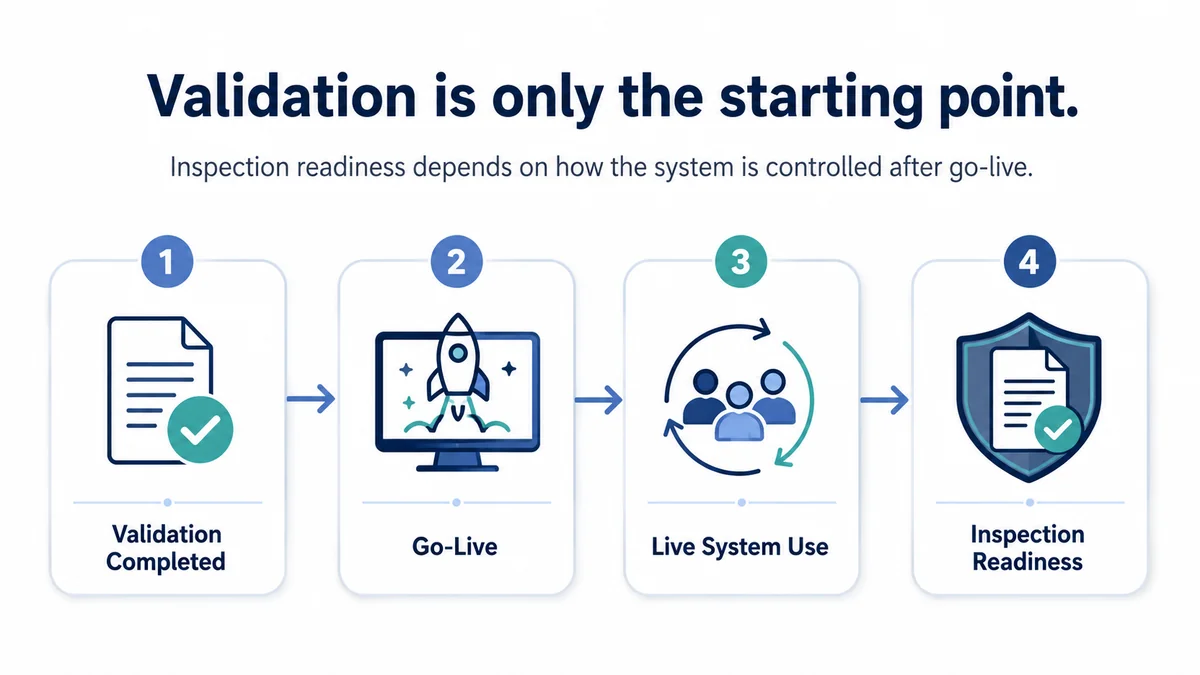
Validation confirms that the system met defined requirements during assessment. Inspection readiness requires evidence that the system remains controlled, traceable, and fit for use in day-to-day pharmacovigilance operations.
Why Validation Needs Ongoing Control
After go-live, PV systems continue to change. Users join and leave. Roles change. Vendors release updates. Configurations are modified. Interfaces are added. Data may be migrated. Teams may also introduce manual trackers outside the validated workflow.
Each of these changes can affect the validated state if it is not assessed and controlled.
Regulators expect organizations to demonstrate that:
- User access is current and role-based
- Audit trails are enabled and reviewed
- System changes are assessed before implementation
- Vendor updates are reviewed for impact on intended use
- Data migrations preserve history, metadata, and traceability
They also expect system outputs to be traceable back to source data, and incidents to be investigated and linked to CAPA where required.
Under EMA GVP expectations, pharmacovigilance records should remain retrievable and traceable, especially when they support safety concerns, timelines, decisions, and regulatory actions.
A validation document alone cannot demonstrate this. The system must continue to produce reliable evidence during routine use.
What Inspectors May Check After Validation
A validated system may still face inspection questions if the live evidence does not match the validated workflow.
Inspectors may check whether the system is still being used as validated, whether active users are current and role-based, and whether audit trails are reviewed and documented.
They may also assess whether the MAH has reviewed the vendor validation package for its own intended use, whether migration preserved metadata and traceability, whether actual system use matches approved SOPs, and whether post-validation changes were properly assessed.
This is where many gaps appear. The documentation may look complete, but the live system evidence may not show the same level of control.
Common Post-Validation Gaps in PV Systems
Most concerns appear after go-live, when system use gradually moves away from the validated process.
| Post-Validation Gap | What This Means in Practice | Inspection Concern |
|---|---|---|
| Outdated access rights | Former users may remain active, or users may have broader access than required for their role. | Inspectors may question whether access control is current, role-based, and periodically reviewed. |
| Unreviewed audit trails | The audit trail may exist, but it may not be reviewed at defined intervals. | Without documented review, the audit trail may not support system control or data integrity expectations. |
| Unassessed system changes | Vendor updates, patches, configuration changes, or workflow updates may be implemented without impact assessment. | Changes may affect the validated state if they are not assessed, approved, and documented. |
| Incomplete migration evidence | Historical records may move into a new system, but metadata, audit history, or full traceability may not be preserved. | Inspectors may question whether migrated data remains complete, accurate, and traceable. |
| Manual workarounds | Teams may rely on spreadsheets or offline trackers for activities that should remain controlled within the validated system. | Manual processes may create gaps in oversight, traceability, and version control. |
| Limited CAPA linkage | A technical issue may be corrected, but the root cause and preventive action may not be properly documented. | Inspectors may question whether the issue was fully investigated and whether recurrence has been prevented. |
For example, if an adverse event record moves from an affiliate to the safety database, then into signal review or CAPA, the organization should be able to show the source record, user actions, review trail, rationale, vendor involvement, and follow-up actions.
If that trail is incomplete, inspection readiness becomes difficult to demonstrate.
A Practical Readiness Check Before Inspection
Before an inspection, organizations should test whether validated systems are still aligned with live operations.
A practical way to do this is to select one real PV activity, such as a case record, signal decision, CAPA, literature screening output, vendor file, or safety report. Then trace it from source to final output.
The review should answer a few important questions:
- Can the full record be reconstructed?
- Are user actions visible and justified?
- Does the process match the approved SOP?
- Are changes and decisions supported by evidence?
- Can the final output be traced back to the original source?
If the answer is unclear, the system may need review before inspection.
How PVCON Consulting Supports System Readiness
A validated system is not inspection-ready unless it remains controlled, traceable, and aligned with live PV operations.
PVCON Consulting supports pharmaceutical, biotechnology, CRO, and medical device organizations through specialized services including GxP Audits, PV Audits, GCP Audits, Other GxP Audits, Pharmacovigilance Consulting, PV Quality Management System support, PvOIC services, Regulatory Intelligence, Medical Writing, Aggregate Report Writing, Clinical Safety Documents, RMP and REMS Writing, PSMF Management, and Training & Upskilling initiatives such as Training Matrix, Regulatory Compliance Training, PV Boot Camp, and Customized Learnings.
Our expertise helps organizations strengthen drug safety operations, improve inspection and audit readiness, and keep PSMF documentation compliant, accurate, and aligned with real-world PV system practices and regulatory expectations.
If you are evaluating your validated PV system or preparing for an inspection, you can contact our team or learn more about us.