ICSR Validation Case Study: Recovering Valid Pharmacovigilance Cases
See how PVCON helped a pharmaceutical company improve ICSR intake, recover valid cases, strengthen validation controls and improve reporting timelines.
- Client
- Pharmaceutical company
- Focus
- ICSR intake review, validation workflow, QC controls and PV process improvement
- Duration
- 12 weeks
Results
- of rejected cases recovered
- 12%of rejected cases recovered
- fewer validation errors
- 60%fewer validation errors
- on-time reporting
- 88% → 99%on-time reporting
- engagement duration
- 12 weeksengagement duration
Recovering Valid Cases Before They Were Lost
How PVCON helped a pharmaceutical company strengthen ICSR intake processes, recover valid safety reports and improve case-processing accuracy.
Valid Safety Cases Were Being Missed During Intake
A pharmaceutical company managing global safety information identified inconsistencies within its Individual Case Safety Report (ICSR) intake process.
Reports received from different sources were being reviewed against minimum criteria requirements, but variations in interpretation were leading to valid cases being rejected or incorrectly classified during initial assessment.
The challenge was not a lack of reporting volume.
The concern was whether every potentially reportable case was being identified, validated and progressed within the required timelines.
The company needed to strengthen its pharmacovigilance processes by improving intake consistency, reinforcing validation criteria and establishing stronger quality controls around case assessment.
Rebuilding the Intake Process Around Consistent Case Assessment
PVCON reviewed the company's ICSR intake workflow to identify where interpretation differences were affecting case validation.
The engagement focused on reassessing previously rejected cases, reviewing the application of minimum criteria, strengthening procedural guidance and improving quality oversight.
The team supported improvements across:
- ICSR intake workflow review
- Case validation assessment
- Procedure updates
- Quality control checkpoints
- Team retraining on case assessment principles
The updated approach was designed to help the organisation make consistent decisions while ensuring that valid safety information progressed through the appropriate pharmacovigilance pathway.
The process improvements were aligned with the principles of a controlled pharmacovigilance quality system, where decisions need to be traceable, documented and supported by defined procedures.
What Needed to Be Strengthened
| PV Process Area | Challenge Identified | PVCON Support | Outcome |
|---|---|---|---|
| ICSR Intake | Valid cases were being rejected during initial review | Reviewed intake workflow and reassessed rejected cases | 12% of rejected cases recovered |
| Case Validation | Inconsistent interpretation of minimum criteria | Updated validation approach and procedures | Validation errors reduced by 60% |
| Quality Controls | Limited checkpoints before case rejection | Added QC reviews and oversight mechanisms | Improved consistency in case decisions |
| Team Capability | Different approaches across reviewers | Conducted targeted team training | Better alignment across case-processing activities |
| Reporting Timelines | Delays caused by rework and corrections | Improved workflow efficiency | On-time reporting increased from 88% to 99% |
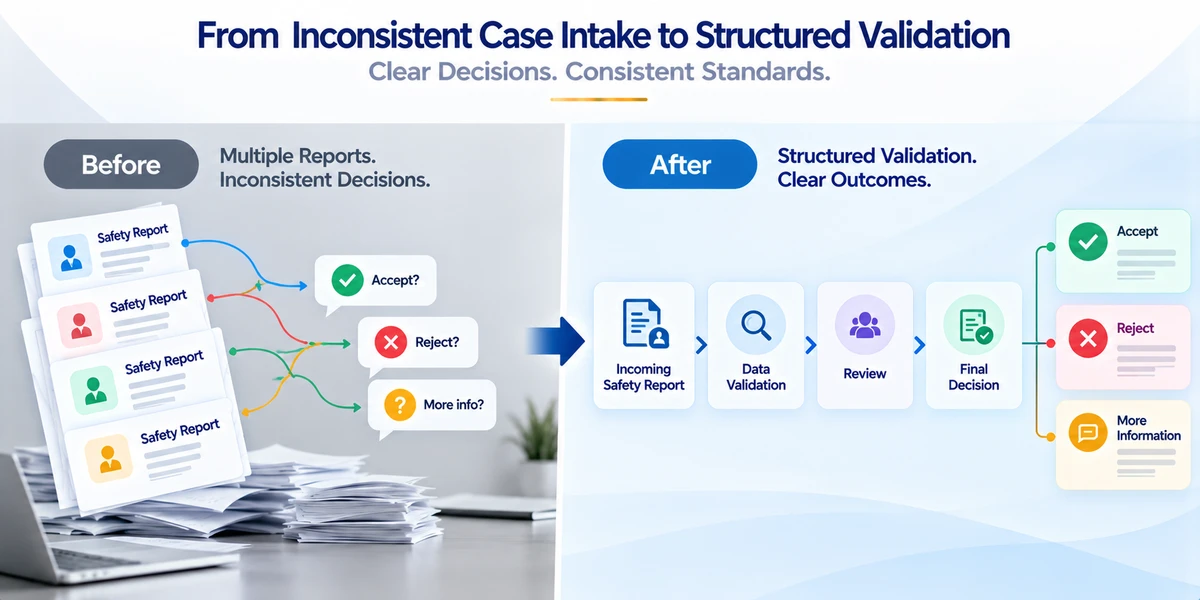
Turning Missed Opportunities Into a More Reliable Safety Process
Through the workflow review and corrective actions, the organisation recovered 12% of previously rejected cases that required further assessment.
The updated validation approach improved consistency across reviewers, reducing validation errors by 60%.
As a result of improved intake controls and reduced rework, on-time reporting performance increased from 88% to 99%.
The outcome was not only improved case processing speed. The organisation gained a more structured approach to identifying, assessing and managing incoming safety information.
Strengthening the First Step of the PV Process
ICSR quality begins before case processing starts.
When intake decisions are inconsistent, the impact can extend across reporting timelines, signal evaluation, aggregate reporting and inspection readiness.
For this organisation, strengthening the intake process created a more reliable foundation for downstream pharmacovigilance activities.
PVCON supports organisations with pharmacovigilance consulting, including process improvement, quality system strengthening, PV audits and inspection readiness support.
Need to improve your ICSR validation process? Explore PVCON's pharmacovigilance consulting support or contact PVCON to discuss strengthening your safety operations.