PV Training Competency Assessment Case Study
See how PVCON helped a pharmaceutical company move beyond training records by building a role-based PV training framework, assessing competency and reducing repeat errors.
- Client
- Pharmaceutical company
- Focus
- PV training framework, competency assessment, role-based learning and quality improvement
- Duration
- 10 weeks
Results
- competency assessment scores
- 68% → 91%competency assessment scores
- fewer repeat errors
- 45%fewer repeat errors
- training coverage
- 100%training coverage
- employees mapped across 8 PV roles
- 35employees mapped across 8 PV roles
Turning Training Records Into Real Competence
How PVCON helped a pharmaceutical company move from attendance-based training records to a role-based competency framework that demonstrated employee readiness.
Training Records Existed. Evidence of Competence Did Not.
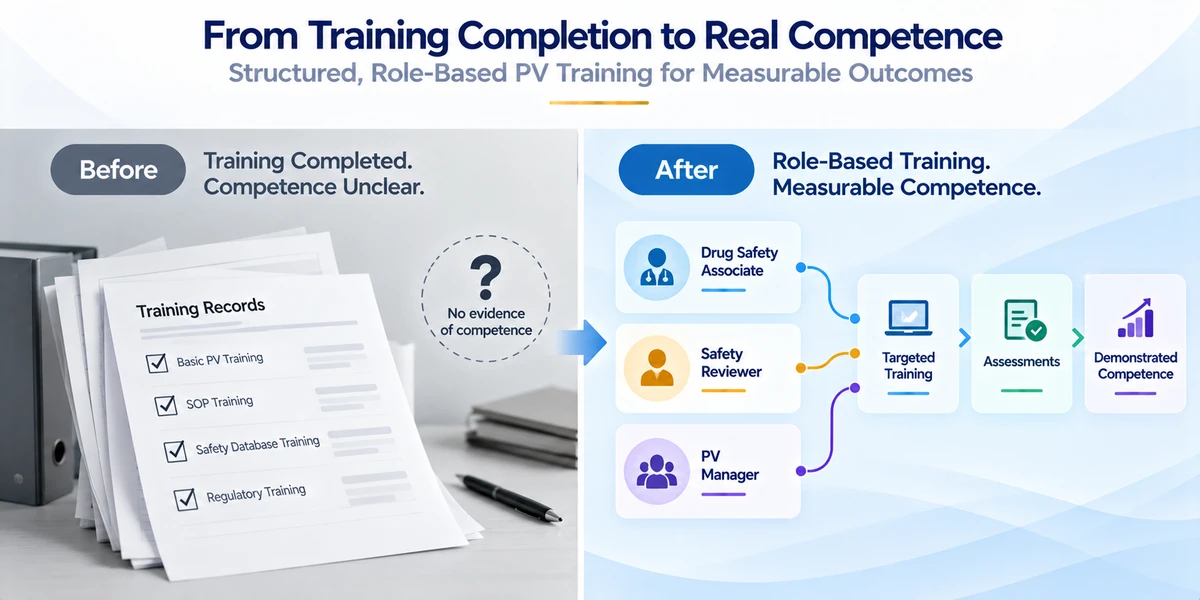
A pharmaceutical company had established pharmacovigilance training processes, but its existing approach focused primarily on completion tracking.
Employees completed read-and-understand documents and training modules, but the organisation had limited evidence showing whether individuals could apply the knowledge required for their specific PV responsibilities.
The challenge became more visible during internal quality reviews, where training completion records alone were not sufficient to demonstrate role-specific capability.
The company needed to move beyond documenting attendance.
It needed a structured PV training and upskilling approach that connected employee roles, required knowledge, practical application and competency assessment.
Building a Training Framework Around Actual PV Responsibilities
PVCON reviewed the organisation's existing training approach and redesigned it around role-specific competency requirements.
The engagement focused on identifying the knowledge and skills required across different PV functions, mapping responsibilities to training needs and introducing measurable competency assessments.
The support included:
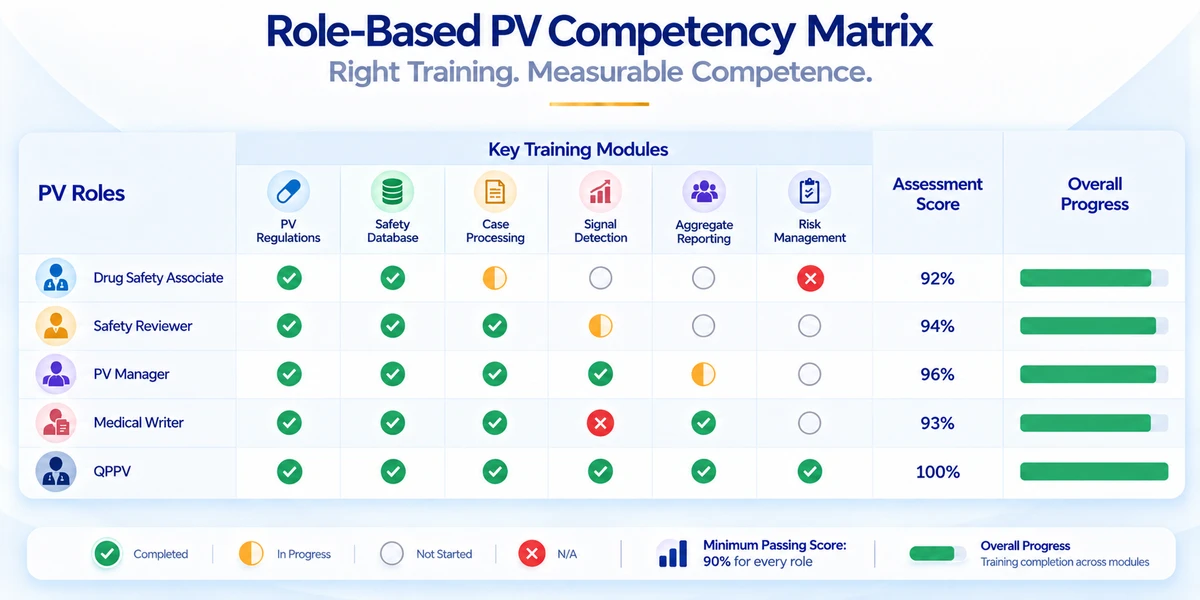
- Role-based training matrix development
- Review of existing training requirements
- Practical PV training sessions
- Competency assessment design
- Training effectiveness evaluation
The updated framework helped the organisation move from a compliance-driven training model to a capability-focused approach.
Each role had clearer expectations around what employees needed to understand, perform and demonstrate.
The approach aligned with the principles of a structured pharmacovigilance quality management system, where training effectiveness forms part of maintaining operational control.
What Needed to Be Strengthened
| Training Area | Challenge Identified | PVCON Support | Outcome |
|---|---|---|---|
| Training Structure | Training completion did not demonstrate role capability | Developed role-based training matrix | 35 employees mapped across 8 roles |
| Competency Assessment | No consistent method to evaluate practical understanding | Introduced competency assessments | Scores improved from 68% to 91% |
| Training Coverage | Different teams had inconsistent learning requirements | Defined role-specific learning pathways | 100% training coverage achieved |
| Knowledge Application | Repeat process errors indicated learning gaps | Delivered practical PV-focused sessions | Repeat errors reduced by 45% |
| Quality Evidence | Limited evidence beyond completion records | Established assessment-based documentation | Stronger training effectiveness evidence |
From Completed Training to Demonstrated Capability
Through the redesigned training framework, the organisation assessed 35 employees across 8 PV roles.
Training coverage reached 100%, ensuring employees had defined learning requirements aligned with their responsibilities.
Competency assessment scores improved from 68% to 91%, demonstrating stronger understanding and application of PV processes.
The organisation also observed a 45% reduction in repeat errors, indicating improved knowledge transfer and better application of procedures during daily operations.
The outcome was not simply a more complete training record.
The company established evidence that employees understood their responsibilities and could apply the required knowledge within their roles.
Building Training Systems That Support Inspection Readiness
Training is not only about completing modules.
During inspections and audits, organisations need to demonstrate that personnel performing pharmacovigilance activities are appropriately trained and competent for their responsibilities.
A read-and-understand record can show that information was provided. It does not always demonstrate that the employee understood it and can apply that knowledge effectively.
For this organisation, introducing competency-based assessment created stronger evidence of training effectiveness and improved confidence in operational readiness.
PVCON supports organisations with customised PV training, training matrices and regulatory compliance training designed around pharmacovigilance responsibilities.
Need to strengthen your PV training framework? Explore PVCON's training and upskilling support or contact PVCON to discuss building a competency-driven learning system.