PSUR, PBRER, PADER & DSUR: What to Outsource vs Control
Compare PSUR, PBRER, PADER and DSUR requirements and learn which aggregate safety reporting activities to outsource and which to control internally.
PSUR, PBRER, PADER & DSUR: Aggregate Report Outsourcing vs Internal Control
The Periodic Benefit-Risk Evaluation Report went out two days before the deadline. The vendor delivered a clean draft, medical review was completed and the submission team moved on.
Three months later, an assessor asked why the report concluded that the benefit-risk balance remained unchanged when the company's signal team had opened an evaluation of a new safety concern during the reporting interval.
The signal team knew. The vendor did not.
The report was on time. It just did not fully represent the company's current safety position.
Under ICH E2C(R2), Section 15 of the PBRER provides an overview of new, ongoing and closed signals, while Section 18 integrates the key benefit and risk information into the overall benefit-risk analysis. A disconnect between the signal process and report authoring can therefore affect the scientific position presented to regulators.
This is the central risk in aggregate report outsourcing.
Key Takeaway
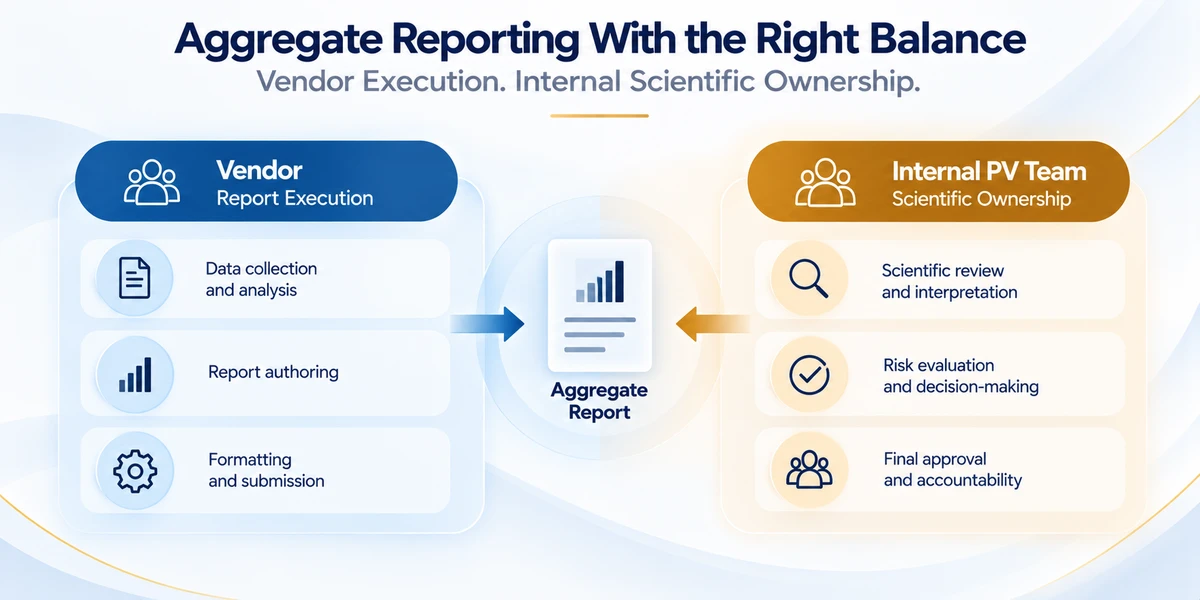
Outsource the authoring. Never outsource the judgement.
External specialists can manage data coordination, drafting, tabulations, QC and submission preparation. The MAH or sponsor needs to retain ownership of signal positions, benefit-risk conclusions, reference safety information, regulatory actions and final approval.
What is the difference between PSUR, PBRER, PADER and DSUR?
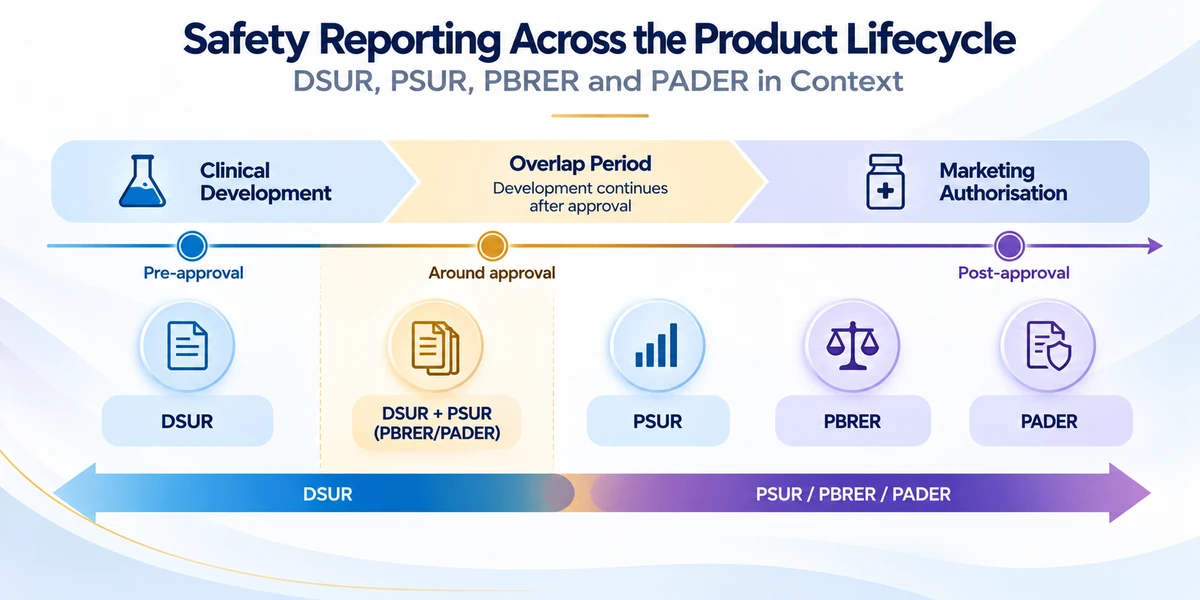
A Periodic Safety Update Report (PSUR) is a post-authorisation safety report required in the EU, India and other markets. A Periodic Benefit-Risk Evaluation Report (PBRER) is the ICH E2C(R2) framework for cumulative benefit-risk evaluation. A Periodic Adverse Drug Experience Report (PADER) is a US post-marketing report for applicable approved drugs. A Development Safety Update Report (DSUR) is an annual report covering investigational products during clinical development.
| Report | Lifecycle Stage | Framework | Typical Timing | Primary Focus |
|---|---|---|---|---|
| PSUR | Post-authorisation | EU GVP / national rules | EU: EURD schedule; India: 6-monthly then annual | Periodic safety and benefit-risk evaluation |
| PBRER | Post-authorisation | ICH E2C(R2) | Based on regional requirements, IBD and DLP | Integrated cumulative benefit-risk evaluation |
| PADER | US post-approval | 21 CFR 314.80 | Quarterly for 3 years, then annually | Periodic adverse drug experience reporting |
| DSUR | Clinical development | ICH E2F | Annual, within 60 days of DLP | Development-stage safety evaluation |
In the EU, the legally binding EURD list sets PSUR frequencies and data lock points where applicable. PSURs covering intervals up to 12 months are generally due within 70 calendar days of the DLP, while longer intervals are due within 90 days. PSURs following the EURD list may enter the PSUR Single Assessment, or PSUSA, procedure. Source: EU PSUR and PSUSA guidance.
In India, PSURs for new drugs are required every six months for the first two years after approval, then annually for the next two years. Reports are due within 30 calendar days of the end of the reporting period. Source: New Drugs and Clinical Trials Rules, 2019.
For applicable US drugs, PADERs are submitted quarterly for the first three years after approval and annually thereafter. Quarterly reports are due within 30 days of quarter close and annual reports within 60 days of the approval anniversary. Biologics are covered separately under 21 CFR 600.80. Source: 21 CFR 314.80.
FDA may also permit use of the PBRER format instead of the traditional US periodic format through the applicable waiver process.
A DSUR is annual and should generally be submitted within 60 calendar days of its DLP. Source: ICH E2C(R2) PBRER Guideline.
PSUR vs PBRER
PSUR is the regulatory reporting term retained in markets including the EU and India. PBRER is the ICH E2C(R2) format centred on integrated benefit-risk evaluation. EU PSUR content is structured around the PBRER approach under GVP Module VII.
PADER vs PSUR
PADER applies to applicable US post-marketing reporting under FDA requirements. PSUR obligations depend on the relevant jurisdiction, so global MAHs need market-specific reporting calendars rather than treating the formats as interchangeable.
DSUR vs PBRER
DSUR addresses development-stage safety. PBRER evaluates the benefit-risk profile of a marketed product. One product can require both when it is marketed in some regions while clinical development continues elsewhere.
For specialist support across these formats, see PVCON's Aggregate Report Writing Services.
Why do aggregate reports go wrong even when they are on time?
Timeliness is the minimum. Coherence is the test.
Aggregate reports combine information from signal management, safety databases, regulatory affairs, clinical development, literature, exposure data and product information. The report can be technically well written while the underlying inputs remain misaligned.
Common failure points include different Reference Safety Information versions, MedDRA-version differences, unreconciled line listings, late literature inputs and signal decisions that do not reach the author before medical review.
In PVCON review work, a recurring focus is input governance: confirming that signal, labelling, regulatory and aggregate-reporting functions are aligned before conclusions are drafted.
PVCON's Signal Decisions in Pharmacovigilance article explains why safety conclusions need to remain traceable to the underlying decision process.
When does aggregate report outsourcing make sense?
Aggregate report outsourcing works best when the organisation needs additional execution capacity without transferring scientific ownership.
It becomes particularly valuable for larger portfolios, overlapping reporting cycles, multi-market requirements and organisations without sufficient in-house medical-writing capacity. It can also provide specialist QC and regulatory-format expertise during reporting peaks.
The decision is ultimately about capacity and expertise, not transferring accountability.
PVCON's Medical Writing Services cover clinical safety and post-authorisation documentation across the product lifecycle.
What can safely be outsourced?
Execution-heavy activities are well suited to external support when responsibilities and source inputs are clearly controlled.
These include data retrieval, line listings, summary tabulations, exposure calculations, literature-input consolidation, regulatory-status compilation, first-draft authoring, formatting, publishing, cross-reference checks and submission-readiness QC.
For DSURs, ICH E2F explicitly allows preparation to be delegated to a third party while retaining sponsor responsibility for preparation, content and submission.
What must remain under internal control?
The company's scientific and regulatory position needs to remain internally owned.
That includes signal and risk-evaluation positions, overall benefit-risk conclusions, Reference Safety Information, labelling decisions, alignment with risk-management activities, significant safety actions, DLP governance and final medical approval.
In the EU, the QPPV has specific responsibilities around ensuring PSUR quality, correctness and completeness, responding to regulatory requests and remaining aware of assessment conclusions and resulting actions. This is an EU-specific role and should not be conflated with India's Local PVoI framework.
A PSUSA outcome can also result in changes to product information and, where applicable, RMP updates or implementing variations. Those follow-up decisions remain part of the MAH's regulatory governance, not simply a writing-vendor activity.
If your team cannot defend a sentence in the report, it should not be in the report.
How do you structure aggregate report outsourcing without losing control?
A hybrid model generally provides the clearest boundary between execution and accountability.
| Activity | Vendor Role | Internal Role | Why It Matters |
|---|---|---|---|
| Data extraction | Execute | Verify completeness | Missing data affects every downstream section |
| Signal sections | Draft from approved inputs | Own positions | Must reflect current signal decisions |
| Benefit-risk analysis | Support drafting | Decide and approve | Represents the company's regulatory voice |
| RSI and labelling | Document changes | Own decisions | Maintains product-information consistency |
| Reporting calendar | Track | Own DLP governance | Accountability remains internal |
The written PV agreement or contract needs to define these responsibilities, including data provision, reconciliation, timelines, review stages and approval authority.
Those controls should also sit within the wider PV Quality Management System.
Where do DSUR and PBRER processes overlap?
Products that are marketed while further clinical development continues may have simultaneous DSUR and PBRER obligations.
Both processes can draw from emerging clinical safety data, signal evaluations, exposure information, regulatory actions and changes to reference safety information. Their objectives differ, but the organisation cannot afford conflicting safety positions across the two reports.
One of the first consistency checks PVCON recommends is comparing signal status, reference safety information and risk conclusions across DSUR, PBRER/PSUR and the RMP before final approval.
Cross-document consistency becomes particularly important when different internal functions or vendors own different reports.
How should an aggregate reporting vendor be overseen?
Vendor oversight starts before drafting.
The kick-off needs to confirm the DLP, reporting interval, data sources, current RSI, signal status, literature ownership, database outputs and relevant regulatory commitments.
Performance metrics should extend beyond on-time submission. Useful measures include:
- First-draft acceptance rate
- Number of substantive review cycles
- Days lost because of delayed inputs
- Cross-document inconsistencies identified during QC
- Assessor questions attributable to report content
For example, repeated late signal inputs may require a governance review rather than simply another authoring-cycle adjustment. Multiple review rounds caused by inconsistent RSI versions may indicate a process weakness outside the vendor itself.
The most effective oversight asks whether the operating model produces a scientifically coherent report, not simply whether the vendor met the delivery date.
For a wider framework on what to retain versus delegate, see PVCON's Pharmacovigilance Consulting and Outsourcing guide.
Aggregate report outsourcing is often commercially sensible. These reports are specialised, cyclical and resource-intensive.
But each submission remains a formal statement of what the company understands about its product.
Before the next submission, ask one question:
Could the internal team defend every material conclusion without calling the vendor?
If the answer is no, the boundary between capacity support and scientific ownership has moved too far.
PVCON Consulting supports pharmaceutical, biotechnology, CRO, and medical device organizations through specialized services including GxP Audits, PV Audits, GCP Audits, Other GxP Audits, Pharmacovigilance Consulting, PV Quality Management System support, PvOIC services, Regulatory Intelligence, Medical Writing, Aggregate Report Writing, Clinical Safety Documents, RMP and REMS Writing, PSMF Management, and Training & Upskilling initiatives such as Training Matrix, Regulatory Compliance Training, PV Boot Camp, and Customized Learnings.
Our expertise helps organizations strengthen drug safety operations, improve inspection and audit readiness, and keep PSMF documentation compliant, accurate, and aligned with real-world PV system practices and regulatory expectations.
Need Support With Aggregate Safety Reporting?
PVCON supports MAHs and sponsors with PSUR, PBRER, PADER and DSUR authoring, reporting strategy, independent quality review and vendor oversight while preserving internal ownership of scientific and regulatory decisions. Contact PVCON Consulting.