PV Vendor Qualification Audits: Beyond the Checklist
Why qualified PV vendors still become inspection findings, which vendors carry hidden risk and how to audit them before an inspector does.
Your Vendor Passed Qualification. But Are They Really PV-Ready? A Guide to Vendor Qualification Audits
The vendor had passed every stage. The questionnaire was complete, SOPs were current and the qualification audit closed with only minor observations.
Fourteen months later, reconciliation identified cases in the vendor tracker that had never reached the MAH safety database.
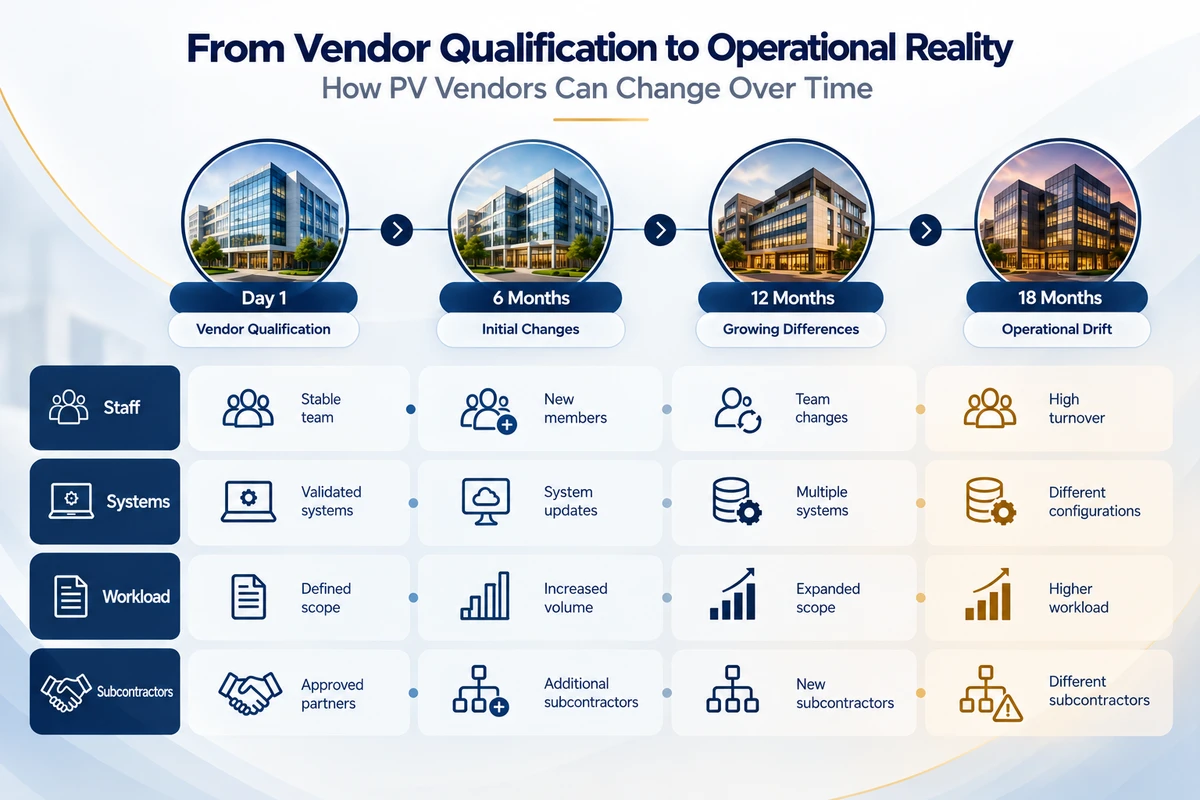
A senior processor had left. Literature screening had moved to another provider. Neither change had triggered meaningful reassessment.
This is an illustrative scenario, but the risk is familiar across outsourced pharmacovigilance models.
Qualification tests the vendor you were shown. Oversight tests the vendor you actually got.
A PV vendor qualification audit should identify more than whether a provider appears capable on approval day. It should establish how changes, performance deterioration and downstream outsourcing will become visible to the MAH.
Key Takeaway
A practical vendor oversight model follows five steps:
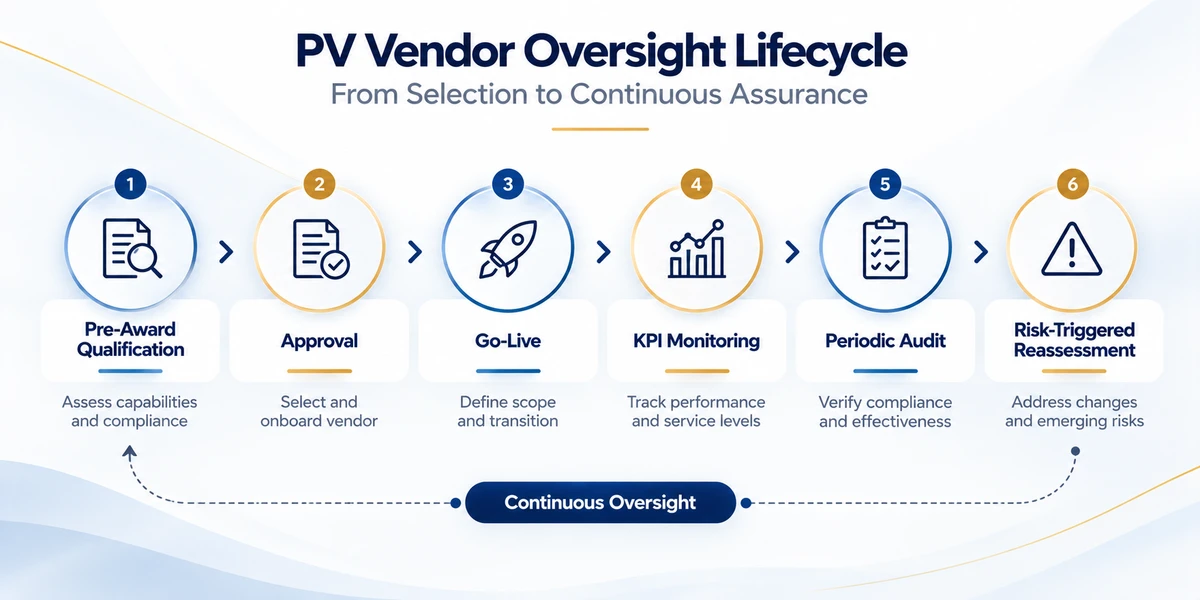
Assess risk → qualify capability → define approval conditions → test live operations → reassess when risk changes.
Qualification is the starting point. Ongoing oversight determines whether the vendor remains suitable.
Why do qualified vendors still become inspection findings?
Vendor qualification is a point-in-time assessment. Pharmacovigilance operations continue to change after approval.
Staff turnover, growing case volumes, system migrations, acquisitions, new clients and subcontracting can alter the control environment without changing the original qualification report.
Under GVP Module I, outsourced pharmacovigilance activities remain within the MAH's ultimate responsibility. GVP Module II requires subcontracted activities and relevant contractual arrangements to be reflected within the PSMF. GVP Module IV supports a risk-based approach to pharmacovigilance auditing.
India's MAH pharmacovigilance guidance similarly places outsourced activities and service-provider relationships within the wider PV system.
For additional context, see PVCON's Risk-Based PV Audit Planning guide.
What does a standard qualification usually miss?
The most significant weaknesses often emerge after the formal qualification process.
| What Qualification Showed | What May Change Later | Potential Concern |
|---|---|---|
| Approved SOPs | Older versions used operationally | Process inconsistency |
| Trained personnel | New joiners lack complete training | Competency weakness |
| Validated safety database | Changes introduced without appropriate assessment | Data integrity concern |
| No subcontracting | Activities transferred downstream | PSMF and oversight weakness |
| Business continuity plan | Plan never tested | Disruption to PV activities |
This is why qualification needs to evaluate both current capability and the vendor's ability to control future change.
PV agreements are particularly important here. PVCON's SDEA Reconciliation and PV Audits article explains how contractual responsibilities can diverge from actual safety-data handoffs.
Which vendors can carry hidden pharmacovigilance risk?
PV exposure extends beyond specialist case-processing and literature vendors.
Market research agencies may receive adverse events through survey responses. Digital agencies can encounter safety information through social media comments. Translation providers may identify adverse-event information within source documents. Distributors, patient support programmes and medical information providers may also receive reportable information.
These organisations need proportionate AE-awareness training, a defined reporting pathway and reconciliation controls where relevant.
The more useful question is not simply, “Is this a PV vendor?”
It is:
Can this provider receive, process, transfer, store or influence safety information?
How should a vendor be assessed before go-live?
A pre-award qualification audit cannot trace your organisation's live cases because none have yet been processed.
Instead, the assessment can include:
- Mock-case or workflow demonstrations
- Anonymised operational examples where permitted
- Safety-system and audit-trail demonstrations
- Business-continuity exercises
- Staffing and capacity assessment
- Subcontractor governance review
Practical capacity questions can reveal risks that capability decks do not.
How many cases does each processor handle? What has staff attrition been during the previous 12 months? How many MAH accounts share the proposed operational team?
The audit should also establish how the primary vendor qualifies, monitors and escalates issues involving its own subcontractors.
At completion, the qualification process should result in a defined decision: approve, conditionally approve subject to CAPA or withhold approval until significant concerns are resolved.
What should be tested after the vendor goes live?
Post-go-live and periodic audits can test actual operational evidence.
A practical review should:
- Trace selected cases from receipt through transfer or submission.
- Reconcile vendor records against the MAH safety database.
- Interview operational personnel, not only vendor management.
- Compare the current account roster with training records.
- Review deviations, system changes and CAPA effectiveness.
- Test business-continuity controls through actual or controlled scenarios.
- Review how subcontractor performance is monitored.
Ask to see the work, not only the procedure for the work.
What should ongoing vendor oversight look like?
Effective pharmacovigilance vendor oversight needs escalation rules, not only dashboards.
For example:
- One missed critical safety-data transfer may trigger documented root-cause review.
- Repeated reconciliation performance below an agreed threshold may trigger a formal governance meeting.
- Recurrence after CAPA may justify a for-cause audit.
- A major system migration may trigger targeted reassessment before implementation.
Other requalification triggers may include substantial volume growth, key personnel departure, acquisition, significant scope expansion or the introduction of a new subcontractor.
PVCON's SDEA and Vendor Oversight Case Study demonstrates why operational oversight matters. Across 28 SDEAs, a backlog of 160 reconciliation records was identified and addressed, while on-time reconciliation improved from 81% to 97%.
For broader audit governance, PVCON's Integrated GxP Audit Programme case study shows how risk-based audit planning and CAPA oversight can be coordinated across functions.
If you cannot clearly explain what changed across your critical vendors during the last twelve months, that is a practical place for the next audit to begin.
PVCON provides independent PV Audit Services covering vendor qualification, service-provider oversight, partner arrangements, SDEA controls, CAPA review and risk-based audit planning.
PVCON Consulting supports pharmaceutical, biotechnology, CRO, and medical device organizations through specialized services including GxP Audits, PV Audits, GCP Audits, Other GxP Audits, Pharmacovigilance Consulting, PV Quality Management System support, PvOIC services, Regulatory Intelligence, Medical Writing, Aggregate Report Writing, Clinical Safety Documents, RMP and REMS Writing, PSMF Management, and Training & Upskilling initiatives such as Training Matrix, Regulatory Compliance Training, PV Boot Camp, and Customized Learnings.
Our expertise helps organizations strengthen drug safety operations, improve inspection and audit readiness, and keep PSMF documentation compliant, accurate, and aligned with real-world PV system practices and regulatory expectations.
Need to Assess a Current or Prospective PV Vendor?
PVCON can independently evaluate vendor readiness before appointment or assess whether existing outsourced pharmacovigilance activities remain controlled in practice.