RMP vs REMS vs aRMMs: What Does Your Product Need?
Understand RMP vs REMS, when aRMMs apply and how MAHs can choose the right risk-management approach before filing.
RMP vs REMS vs aRMMs: When Does Your Product Actually Need a Risk Management Strategy?
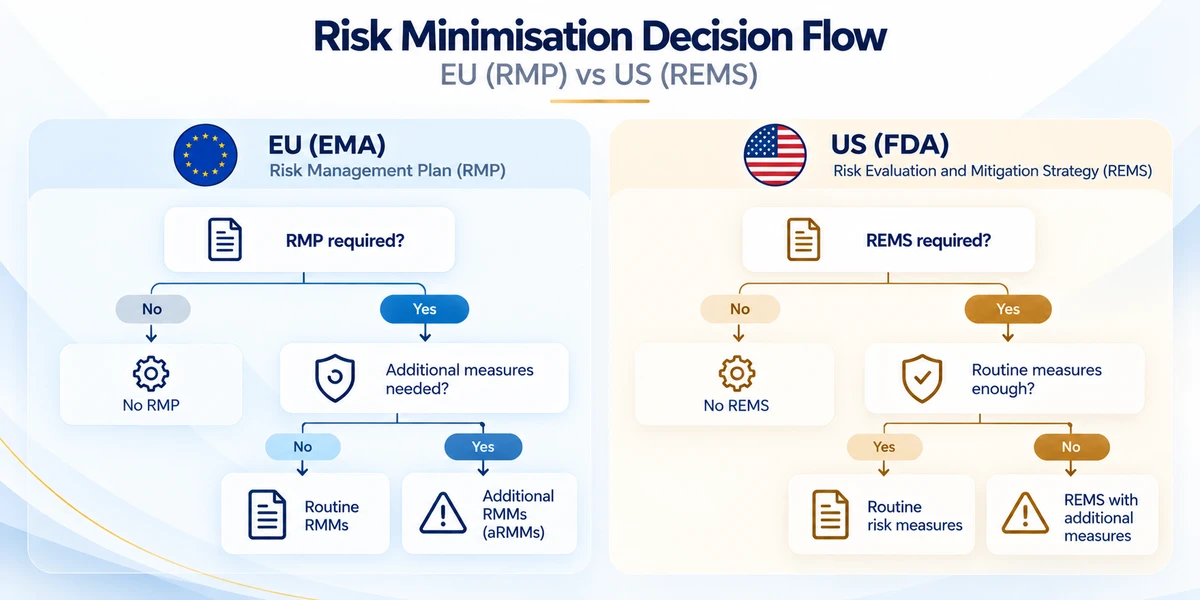
RMP, REMS and additional Risk Minimisation Measures (aRMMs) are not interchangeable. An EU Risk Management Plan (RMP) provides the broader risk-management framework, while a US Risk Evaluation and Mitigation Strategy (REMS) and EU aRMMs apply only when additional controls are justified.
Consider an illustrative scenario.
A mid-sized Marketing Authorisation Holder (MAH) has an approved European product with an established RMP. As it prepares for a US filing, the team assumes the European risk-management package has already answered most of the US questions.
Late in review, FDA determines that additional safe-use controls need to be addressed. Prescriber certification, pharmacy controls or patient enrolment now need to be assessed close to launch.
Another company may make the opposite mistake and spend months building a REMS-like infrastructure that FDA never requires.
The question is not which acronym you need. It is what the regulator expects for this specific risk, in this specific market.
Key Takeaway
Start with the jurisdiction and the risk. Use additional controls only when routine measures cannot adequately manage that risk.
What Is the Difference Between RMP, REMS and aRMMs?
| Concept | Region | Mandatory or conditional? | Main trigger |
|---|---|---|---|
| RMP | EU, with separate UK requirements | Required for initial EU MAAs | Marketing authorisation and lifecycle risk management |
| aRMMs | EU | Conditional | Routine risk minimisation is insufficient |
| REMS | US | Conditional | FDA determines additional measures are necessary to ensure benefits outweigh risks |
An RMP describes the product's safety specification, pharmacovigilance activities and risk-minimisation approach. For initial EU marketing authorisation applications, an RMP is required irrespective of legal basis, although its content follows proportionality principles under GVP Module V.
aRMMs sit within the EU risk-management framework. Under GVP Module XVI, they are used when routine measures such as the Summary of Product Characteristics (SmPC), package leaflet and labelling are not enough.
A REMS is a US FDA-required programme used only when additional measures are necessary to ensure that a medicine's benefits outweigh its risks. It can apply to products submitted through New Drug Applications and Biologics License Applications.
A simple analogy:
- RMP: the full safety blueprint
- aRMMs: extra locks on specific doors
- REMS: a US-specific regulatory security system required when additional controls are necessary
When Does Your Product Actually Need Each One?
Are you filing a new MAA in the EU?
An RMP is required.
The real question is not whether the medicine is risky enough to need one. It is what safety concerns, pharmacovigilance activities and risk-minimisation measures the RMP should contain.
Are routine risk minimisation measures enough?
If routine controls can manage the risk, an aRMM may not be necessary.
Additional measures can include patient or healthcare professional educational materials, checklists, patient cards and, in more controlled situations, qualification, traceability or documented clinical requirements.
More controls are not automatically better risk management.
When is a REMS required?
A REMS is required when FDA determines that additional measures are necessary to ensure benefits outweigh risks.
FDA considers six statutory factors:
- Seriousness of known or potential adverse events
- Expected benefit
- Seriousness of the disease
- Whether the medicine is a new molecular entity
- Treatment duration
- Estimated population likely to use the medicine
No single factor automatically triggers a REMS.
Where necessary, Elements to Assure Safe Use (ETASU) can introduce requirements such as prescriber certification, pharmacy certification, controlled healthcare settings, patient monitoring or enrolment. See the FDA REMS framework.
What about generics and biosimilars?
Follow-on products may also inherit risk-management obligations.
In the EU, generic and biosimilar applicants may need risk-minimisation measures aligned with the reference medicinal product. In the US, generic versions of products subject to REMS must meet applicable REMS requirements, sometimes through shared systems.
Where Do Companies Get It Wrong?
Assuming the EU RMP satisfies FDA. The scientific safety position may overlap, but one regulatory document does not replace another market's requirements.
Adding aRMMs "to be safe". Every additional measure needs a clear rationale, defined objective and proportionate level of burden.
Ignoring local implementation timelines. EU-level agreement does not complete implementation. Educational materials may still require review and approval by national competent authorities before launch.
Treating the RMP as static. New safety information, signal conclusions or changes in risk-minimisation activities can require RMP updates. Strong signal-management governance therefore matters.
A practical global approach is to maintain one controlled core safety position and use it to inform market-specific RMP, REMS and local risk-management decisions.
How Do You Know Whether Risk Minimisation Is Working?
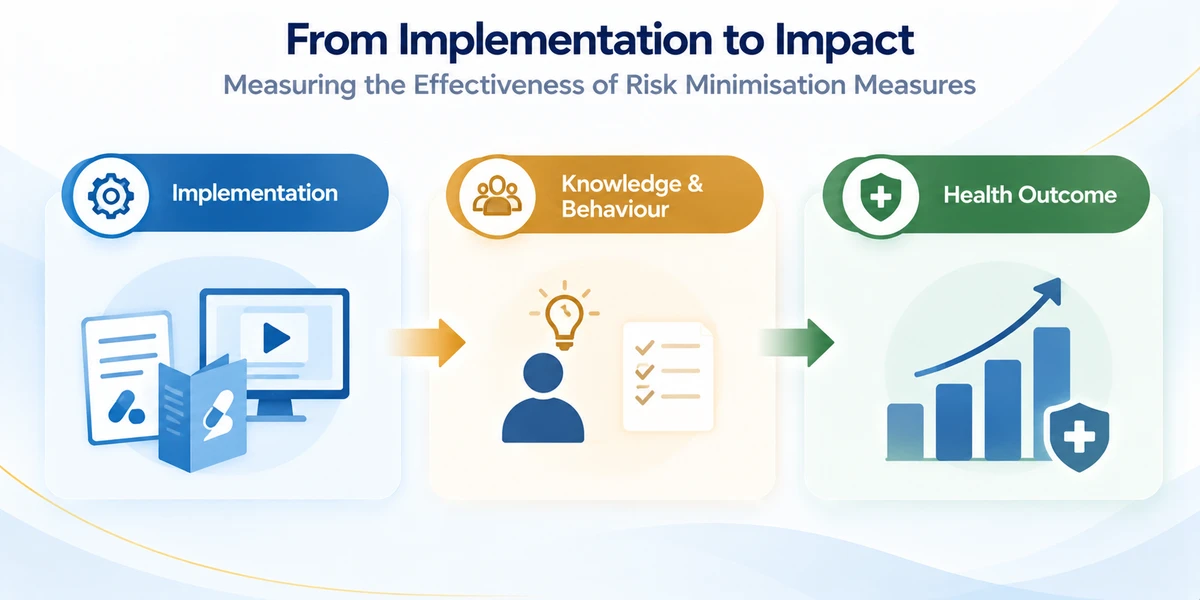
Implementation alone does not prove effectiveness.
A useful three-level framework is:
Implementation: Did the intended audience receive the intervention?
Knowledge and behaviour: Did patients or healthcare professionals understand and perform the required action?
Health outcome: Did the intervention contribute to reducing the risk or its consequences?
This is one of the most important distinctions in risk-based pharmacovigilance oversight.
In the US, statutory REMS assessment milestones generally include 18 months, 3 years and 7 years after approval, although FDA may require different or additional timings.
Can Teams Benchmark Similar Products?
Yes.
FDA's REMS resources and public dashboard allow teams to review active and released programmes, ETASU and shared systems.
EMA also publishes RMP documents for centrally authorised products. Since October 2023, EMA publishes the RMP body and specified annexes rather than new RMP summaries.
Benchmarking should inform thinking, not encourage copying. Similar risks can require different controls depending on indication, treatment setting, population and preventability.
What Should a PV Head Ask Before Filing?
- Which regulator is making the decision?
- What specific safety concern are we managing?
- What patient or HCP behaviour needs to change?
- Can routine controls achieve that outcome?
- If not, what is the least burdensome additional measure?
- How will effectiveness be demonstrated?
- What evidence would justify modifying or removing the measure later?
The Right Strategy Is Proportionate, Not Maximal
The strongest approach is not to build the largest programme early. It is to define the risk, understand what behaviour must change and select the level of control each regulator can justify.
That may mean routine measures within an RMP. It may mean targeted aRMMs. In the US, it may mean a REMS with ETASU.
Risk management is not about doing more. It is about doing exactly what the risk demands and proving that it works.
PVCON Consulting supports MAHs through RMP and REMS writing, pharmacovigilance strategy and PV audit support.
PVCON Consulting supports pharmaceutical, biotechnology, CRO, and medical device organizations through specialized services including GxP Audits, PV Audits, GCP Audits, Other GxP Audits, Pharmacovigilance Consulting, PV Quality Management System support, PvOIC services, Regulatory Intelligence, Medical Writing, Aggregate Report Writing, Clinical Safety Documents, RMP and REMS Writing, PSMF Management, and Training & Upskilling initiatives such as Training Matrix, Regulatory Compliance Training, PV Boot Camp, and Customized Learnings.
Our expertise helps organizations strengthen drug safety operations, improve inspection and audit readiness, and keep PSMF documentation compliant, accurate, and aligned with real-world PV system practices and regulatory expectations.
Need Support With an RMP, REMS or Risk Minimisation Strategy?
Contact PVCON Consulting to discuss RMP preparation, REMS strategy, additional risk minimisation measures and effectiveness evaluation.