GxP Audit Services: Build One Risk-Based Program
GxP audit services explained: build one risk-based program across PV, GCP, CSV, GMP, and vendors without losing technical depth.
GxP Audit Services: How to Build One Risk-Based Program Across PV, GCP, CSV, GMP, and Vendors
A life sciences organization may maintain separate audit plans for pharmacovigilance, clinical operations, manufacturing, computerized systems, and vendors. Each plan may appear complete, yet the same provider, system, or process may be assessed differently across functions.
This can lead to duplicate reviews, inconsistent risk ratings, unclear ownership, and gaps between regulated activities.
GxP audit services should create one coordinated view of risk while preserving the technical depth required for PV, GCP, GMP, CSV, and vendor audits.
Key Takeaway
A unified GxP audit program should use one governance structure, one auditable universe, and a consistent risk methodology. Audit scope, criteria, and auditor competence should still reflect the requirements of each GxP domain.
Why Separate Audit Plans Create System-Level Weaknesses
A contract research organization may support both clinical trials and safety reporting. A cloud provider may host an electronic trial master file, safety database, and quality-management system. Recording the same entity in separate trackers can lead to conflicting owners, ratings, and review dates.
For example, one function may classify a shared vendor as high risk while another considers the same vendor low risk. This can result in conflicting audit schedules, repeated requests, delayed follow-up, or an important activity being left outside the agreed scope.
A coordinated audit program reduces this risk by assigning one owner, one entity record, and clearly defined domain responsibilities.
The regulatory frameworks support integration at the governance level, not identical technical execution. EMA GVP Module IV defines pharmacovigilance auditing as systematic, independent, documented, and risk-based. ICH E6(R3) promotes proportionate, risk-based quality management for clinical trials. EU GMP Chapter 9 requires self-inspections under a prearranged program, conducted independently by competent personnel.
How GxP Audit Services Should Build One Program
Step 1: Define Cross-Functional Governance
Assign one committee or quality function to approve the methodology, review the schedule, resolve overlaps, and escalate cross-domain risks.
A central policy can define planning, reporting, CAPA follow-up, and escalation. Domain-specific procedures should govern PV audits, GCP audit services, GMP audit planning, CSV audit activities, and vendor reviews.
Step 2: Build One Auditable Universe
Create a controlled inventory of every process, site, affiliate, computerized system, and external party that may require assurance.
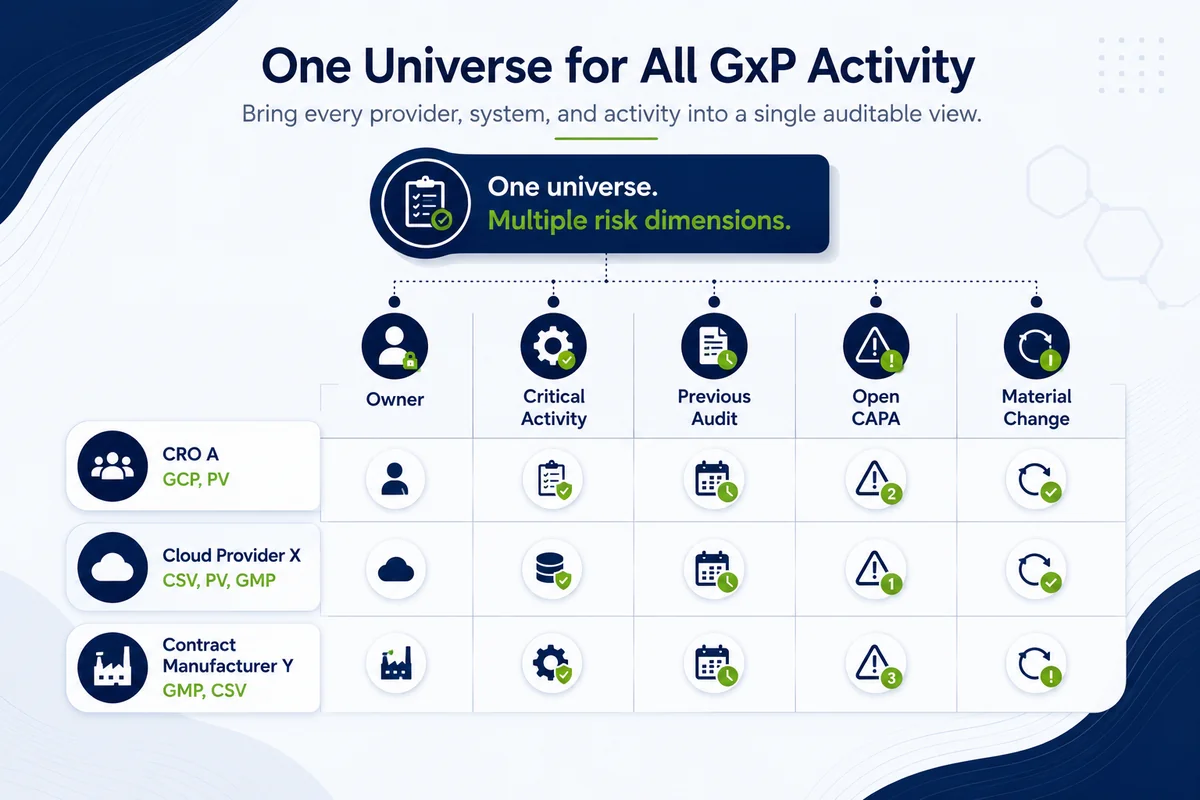
Record each entity once, then apply all relevant domain tags. Include the owner, critical activities, regulated data, previous coverage, open CAPAs, and significant changes.
For example, a CRO performing trial monitoring and safety-information transfer should appear as one entity tagged GCP and PV.
If the CRO is listed separately in different trackers, changes in scope, open CAPAs, or previous findings may not be visible to all responsible teams. Recording the provider once, with all relevant domain tags, creates a more complete risk view.
Step 3: Use Shared Risk Factors With Domain-Specific Weighting
A single rigid formula should not be applied across every GxP activity.
ICH Q9(R1) states that the effort, formality, and documentation used in quality risk management should be proportionate to risk. It also recognizes that poor scoring scales and stakeholder bias can introduce subjectivity.
A shared model may consider patient impact, product-quality impact, data integrity, regulatory criticality, complexity, change history, previous findings, and CAPA performance.
The weighting must reflect the activity. Reporting timeliness may be central to a pharmacovigilance audit program. Sterility assurance may dominate a GMP assessment. Access controls, data flows, change management, and validated status may drive a CSV audit.
To maintain consistency, organizations should use shared risk factors but define domain-specific weighting and decision criteria. The rationale for each rating should be documented so that audit priorities can be explained and reviewed.
Step 4: Translate Risk Into Scope, Method, and Timing
Avoid automatic rules such as auditing every high-risk entity annually.
GVP Module IV distinguishes a long-term audit strategy, usually covering two to five years, from the annual audit program and individual engagement plans. Timing, periodicity, and scope should be supported by documented risk assessment.
The response may be an onsite audit, remote audit, targeted review, follow-up audit, or another assurance activity. Lower intensity should result from lower risk, not limited resources.
Step 5: Standardize the Lifecycle and Reassess Risk
Use one lifecycle for initiation, fieldwork, reporting, CAPA management, effectiveness review, and escalation. Technical evidence and finding definitions should remain domain-specific.
A shared taxonomy can reveal recurring themes such as data integrity, document control, training, vendor oversight, or weak root-cause analysis without forcing every finding into one grading model.
Update risk profiles after audits, inspections, significant changes, repeated deviations, or ineffective CAPAs.
Keep Vendors and Computerized Systems Inside the Same Model
A vendor may support several regulated activities while being managed primarily by procurement, IT, or one operational function. If that vendor remains outside the central audit universe, important quality, data-integrity, or regulatory risks may not be assessed consistently.
Vendors and computerized systems should therefore be included in the same risk-based model, even when different specialists are responsible for the technical review.
EU GMP Annex 11 requires clear third-party responsibilities and states that the need to audit a supplier should be based on risk. It also expects supplier quality and audit information to be available to inspectors.
A safety database provider, cloud host, contract manufacturer, CRO, and literature-screening provider should appear in the same universe, even when different specialists conduct the reviews.
Protect Auditor Independence and Technical Competence
One program does not mean one auditor.
GVP Module IV requires pharmacovigilance audit activity to remain independent and expects auditors to possess appropriate knowledge, skills, and experience. Cross-domain engagements may require a multidisciplinary team rather than one generalist.
Before assigning an engagement, the organization should confirm that the audit team has the required domain knowledge, technical experience, and independence. Specialists can work within one coordinated program without using one checklist or one auditor for every area.
Build One Program Without Losing Domain Depth
A risk-based GxP audit program should connect risk decisions, schedules, findings, and CAPAs while preserving domain-specific examination.
PVCON Consulting provides GxP audit services, including dedicated PV audits, GCP audits, and other GxP audits, to help organizations assess fragmented programs and strengthen cross-functional governance.
PVCON Consulting supports pharmaceutical, biotechnology, CRO, and medical device organizations through specialized services including GxP Audits, PV Audits, GCP Audits, Other GxP Audits, Pharmacovigilance Consulting, PV Quality Management System support, PvOIC services, Regulatory Intelligence, Medical Writing, Aggregate Report Writing, Clinical Safety Documents, RMP and REMS Writing, PSMF Management, and Training & Upskilling initiatives such as Training Matrix, Regulatory Compliance Training, PV Boot Camp, and Customized Learnings.
Our expertise helps organizations strengthen drug safety operations, improve inspection and audit readiness, and keep PSMF documentation compliant, accurate, and aligned with real-world PV system practices and regulatory expectations.
If you are designing or independently reviewing a risk-based GxP audit program, you can contact our team or learn more about us.